


What's Happening?
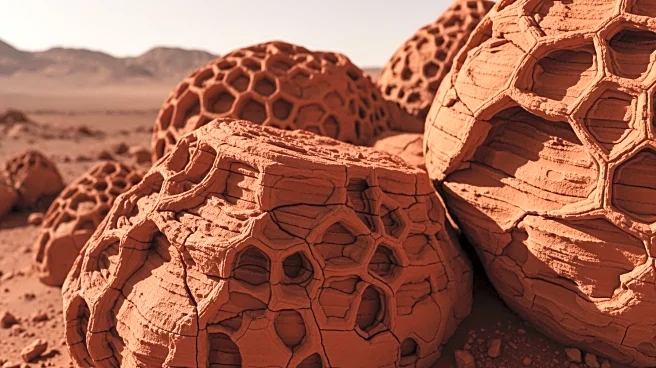
NASA's Curiosity rover has completed a detailed investigation of the Martian boxwork terrain, a significant geological feature on the planet's surface. Over the course of several Martian days, known as sols, the rover conducted a series of scientific
observations and engineering activities. These included imaging various geological targets, analyzing rock compositions with its ChemCam laser spectrometer, and studying atmospheric conditions. The rover's exploration focused on the southern reaches of the boxwork terrain on Mount Sharp, where it captured detailed images and data to understand the area's geological history. The mission involved multiple rover drives and the use of various instruments to gather in-situ data, contributing to a comprehensive understanding of the Martian environment.
Why It's Important?
The completion of this phase of the Curiosity rover's mission is crucial for advancing our understanding of Mars' geological history and its potential to have supported life. By analyzing the composition and structure of the boxwork terrain, scientists can infer the planet's past environmental conditions, including the presence of water. This information is vital for future missions, including those aimed at human exploration. The data collected by Curiosity helps refine models of Martian geology and climate, providing insights that are essential for planning future exploration and potential colonization efforts.
What's Next?
Following the conclusion of its investigation of the boxwork terrain, Curiosity will continue its journey across Mars, targeting new areas of scientific interest. The rover's next steps involve crossing into the sulfate unit, a region that may hold further clues about the planet's past. As Curiosity moves forward, it will continue to use its suite of scientific instruments to gather data, contributing to the broader goals of the Mars Science Laboratory mission. The ongoing analysis of collected data will inform future missions, including those under NASA's Artemis program, which aims to establish a sustainable human presence on the Moon and eventually Mars.