
What's Happening?
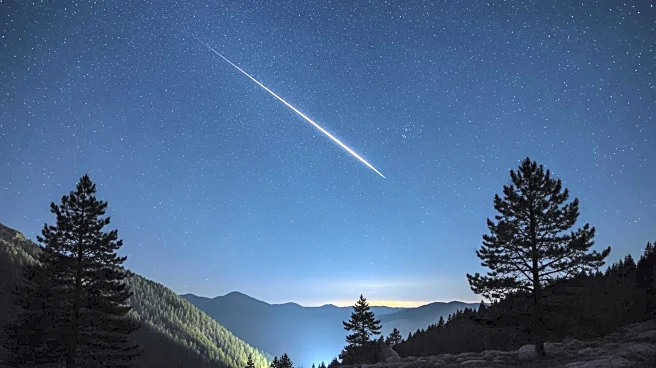
Montana residents are set to witness a spectacular celestial event this weekend as the Geminid Meteor Shower reaches its peak. Scheduled to occur overnight on December 13 and 14, the meteor shower is expected to provide a stunning display, with the moon's
waning phase minimizing interference. The Geminid Meteor Shower is unique because it originates from an asteroid rather than a comet, making it one of the most impressive meteor showers observable from Earth. This year, the shower is anticipated to be particularly strong, continuing a trend observed over nearly 200 years. Additionally, the 3I/Atlas comet, an interstellar object, will make its closest approach to Earth on December 19, although it will remain too distant to be seen without optical aids. Weather conditions, as reported by the National Weather Service, suggest that parts of Montana may experience clear skies, enhancing the visibility of this celestial event.
Why It's Important?
The Geminid Meteor Shower offers a rare opportunity for both amateur and professional astronomers to observe a significant astronomical event. Such events not only provide a chance for scientific observation and study but also engage the public's interest in astronomy and science. The visibility of the meteor shower in Montana could boost local tourism, as enthusiasts may travel to areas with optimal viewing conditions. Additionally, the presence of the 3I/Atlas comet, although not visible to the naked eye, underscores the importance of ongoing space exploration and monitoring of celestial bodies. These events highlight the dynamic nature of our solar system and the potential for future discoveries.
What's Next?
As the Geminid Meteor Shower peaks, astronomers and enthusiasts will likely gather in areas with minimal light pollution to maximize their viewing experience. The National Weather Service's forecast of clear skies in parts of Montana could lead to increased public interest and participation in viewing events. Following the meteor shower, attention may shift to the 3I/Atlas comet's approach, with scientists continuing to study its trajectory and characteristics. This ongoing observation could provide valuable data for understanding interstellar objects and their interactions with our solar system.