



What's Happening?
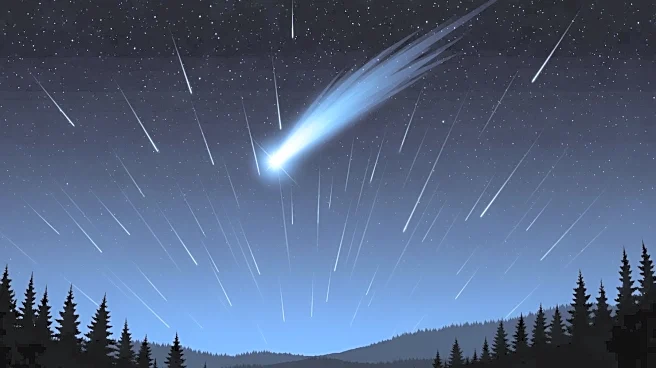
December is set to be a spectacular month for skywatchers, with several celestial events taking place. Comet 3I/ATLAS, an interstellar visitor, will make its closest approach to Earth on December 19. This comet is only the third object discovered from
outside our solar system, and NASA is studying it using spacecraft and telescopes. Additionally, the Geminid meteor shower, known for its bright and colorful meteors, will peak on December 13 and 14. These meteors originate from debris left by the asteroid 3200 Phaethon and will be visible near Jupiter. The month also features a conjunction of the Moon and Jupiter on December 7.
Why It's Important?
These celestial events offer a unique opportunity for both amateur and professional astronomers to observe and study rare cosmic phenomena. The passage of Comet 3I/ATLAS provides valuable data on interstellar objects, which can enhance our understanding of the solar system's formation and the potential for life beyond Earth. The Geminid meteor shower, one of the year's most anticipated events, allows for public engagement and education in astronomy, fostering interest in space science. Such events also highlight the importance of continued investment in space exploration and observation technologies.
What's Next?
As these events unfold, observatories and astronomy clubs are likely to host viewing sessions, providing the public with access to telescopes and expert guidance. NASA and other space agencies will continue to monitor and analyze data from Comet 3I/ATLAS, potentially leading to new insights into interstellar objects. The success of these observations could influence future missions aimed at studying similar phenomena, further expanding our knowledge of the universe.