
What's Happening?
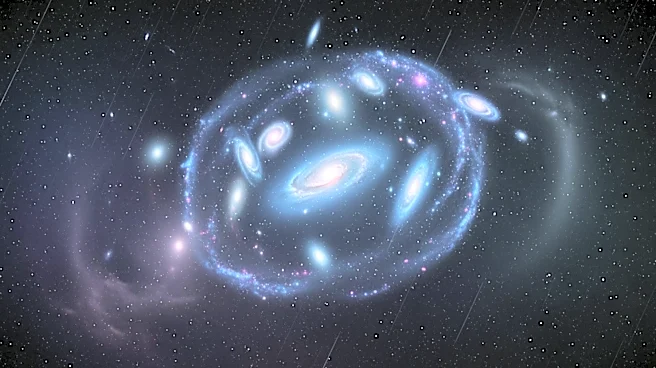
The Dark Energy Spectroscopic Instrument (DESI) has completed the largest and most detailed 3D map of the universe, covering 11 billion years of cosmic history. This project, conducted at the Kitt Peak
National Observatory in Arizona, exceeded its initial goals by capturing data from over 47 million galaxies and quasars. The map aims to shed light on dark energy, a mysterious force believed to constitute about 70% of the universe. DESI's observations suggest that dark energy might be weakening, challenging previous assumptions about its constancy.
Why It's Important?
This map provides an unprecedented resource for understanding the universe's expansion and the role of dark energy. By comparing the distribution of galaxies over time, scientists can gain insights into how the universe has evolved. The findings could lead to a paradigm shift in cosmology, affecting theories about the universe's fate and the fundamental forces that govern it. The project also highlights the collaborative efforts of over 900 researchers from 70 institutions, showcasing the global nature of scientific inquiry.
What's Next?
DESI will continue to expand the map until 2028, focusing on challenging areas like the Milky Way's plane. Researchers will analyze the data to uncover new features of dark energy and refine their understanding of cosmic evolution. The project will also contribute to the development of new analytical techniques and foster international collaboration in astrophysics.
Beyond the Headlines
The vast amount of data collected by DESI presents both opportunities and challenges for researchers. As the scientific community processes this information, it may lead to unexpected discoveries and innovations. The project also underscores the importance of large-scale scientific endeavors in addressing complex questions about the universe.