




What's Happening?
U.S. Representative Rick Crawford is leading an initiative to create commemorative coins honoring the victims of the Sultana steamboat disaster. Actor Sean Astin, executive producer and narrator of the documentary 'Remember the Sultana,' has publicly
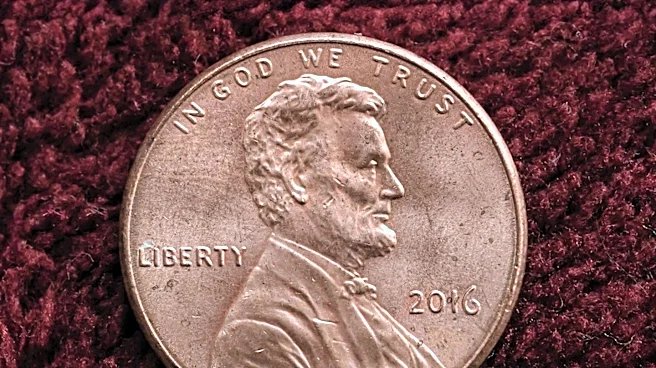
supported Crawford's efforts, viewing the coins as a crucial 'touchpoint' to acknowledge the tragedy. The proposed legislation, H.R. 7801, introduced in 2024, suggests issuing $5 gold coins, $1 silver coins, and half-dollar coins in 2027. These coins would include surcharges of $35, $10, and $5, respectively, with the proceeds benefiting the Sultana Historical Preservation Society. The funds are intended to support the construction, exhibits, artifact preservation, and operational reserves of the Sultana Disaster Museum. The measure also stipulates that the U.S. Treasury must recover the program's costs before distributing funds, ensuring no net cost to the federal government. The Sultana steamboat disaster, which occurred on April 27, 1865, near the Arkansas bank of the Mississippi River, is considered the deadliest maritime disaster in U.S. history, with an estimated 1,200 lives lost. Many of the victims were Union soldiers returning home from Confederate prison camps.
Why It's Important?
This initiative is important for several reasons, primarily for historical recognition and cultural preservation. The Sultana disaster, despite its immense loss of life, has received limited public recognition due to its timing, overshadowed by President Lincoln's assassination and the end of the Civil War. The commemorative coins aim to rectify this historical oversight, bringing national attention to a significant event in U.S. history. Financially, the coin sales are designed to provide substantial support for the Sultana Disaster Museum in Marion, Arkansas. This funding is crucial for the museum's long-term sustainability, enabling it to maintain exhibits, preserve artifacts, and educate future generations about the tragedy. The bipartisan support for Crawford's measure, including U.S. Senators John Boozman and Tom Cotton, and U.S. Representative Steve Cohen, highlights a shared commitment to historical remembrance and community development. The project also sets a precedent for how historical tragedies can be memorialized through federal initiatives, potentially inspiring similar efforts for other under-recognized historical events.
What's Next?
The next steps involve the progression of H.R. 7801 through the legislative process. While the bill was introduced in 2024, its passage would authorize the U.S. Mint to produce the commemorative coins in 2027. The Sultana Disaster Museum is also preparing for a significant milestone, with its grand opening at a new location in Marion scheduled for November 14, 2026. The success of the coin program will directly impact the museum's ability to fund its new facilities and ongoing operations. Continued advocacy from Representative Crawford, Sean Astin, and other supporters will be crucial in garnering the necessary legislative approval and public awareness. The bipartisan nature of the support suggests a reasonable chance for the bill's eventual passage, which would then trigger the design and minting process for the coins. The public will likely see further announcements regarding the legislative status of H.R. 7801 and updates on the museum's development as the grand opening date approaches.
Beyond the Headlines
Beyond the immediate goal of memorializing the Sultana disaster, this effort touches upon broader themes of national memory and the role of historical preservation in shaping collective identity. The limited public awareness of the Sultana tragedy underscores how historical narratives can be influenced by concurrent major events. By actively seeking to elevate this story, Representative Crawford and his supporters are engaging in a form of historical reclamation, ensuring that the sacrifices and experiences of those affected are not forgotten. The project also highlights the economic impact of cultural initiatives, as the museum's growth can stimulate local tourism and create educational opportunities. Ethically, the initiative raises questions about which historical events are chosen for national commemoration and the criteria used for such selections. The use of commemorative coins as a funding mechanism for historical societies and museums could serve as a model for other preservation efforts across the nation, demonstrating a sustainable way to support cultural institutions while honoring significant historical moments.