







What's Happening?
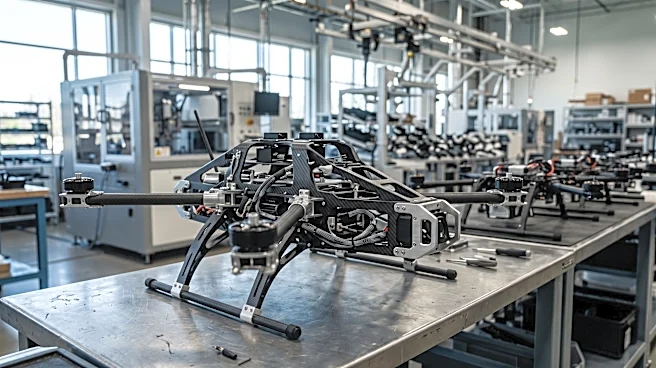
Neros Technologies has announced a conditional loan commitment of $450 million from the Office of Strategic Capital (OSC). This funding is designated to accelerate the vertically integrated manufacturing of multiple drone platforms and their essential
components within the United States. In addition to the OSC commitment, Neros Technologies is investing $165 million in equity, bringing the total project investment to $615 million. This substantial capital injection aims to enable Neros to achieve a production capacity of one million drones per year by 2028. WilmerHale advised Neros Technologies throughout the process of securing this loan commitment. The legal team from WilmerHale was led by Nathan Moore and included Daniel Zimmermann, Jessica Lewis, William A. Caporizzo, Shafi Armatis, Michael Katz, Elizabeth Greene, and Kavya Madhavpeddi.
Why It's Important?
This significant investment is crucial for bolstering the United States' domestic drone industrial base and advancing its position in global drone technology. By accelerating vertically integrated manufacturing, the U.S. aims to reduce reliance on foreign supply chains for critical drone components, enhancing national security and technological sovereignty. The goal of producing one million drones annually by 2028 signifies a major push towards achieving drone dominance, which has implications for defense, commercial applications, and technological innovation. This initiative also supports job creation and economic growth within the U.S. manufacturing sector, particularly in high-tech fields. The involvement of the Office of Strategic Capital underscores the strategic importance the U.S. government places on developing advanced domestic capabilities in critical technologies like drones.
What's Next?
With the $450 million conditional loan commitment and Neros Technologies' equity contribution, the immediate next step for Neros will be to scale up its manufacturing operations significantly. This will involve expanding facilities, investing in advanced production technologies, and potentially hiring a substantial workforce to meet the ambitious target of one million drones per year by 2028. The Office of Strategic Capital will likely monitor Neros's progress to ensure the funds are utilized effectively towards establishing a robust U.S. drone industrial base. This development could also spur further investments in related defense technology and advanced manufacturing sectors, as the U.S. seeks to solidify its leadership in drone technology. Other companies in the defense and technology sectors may look to similar government partnerships to accelerate their own domestic production capabilities.
Beyond the Headlines
This development extends beyond mere industrial expansion; it represents a strategic pivot in U.S. national security and economic policy. By focusing on vertically integrated manufacturing, the initiative addresses vulnerabilities exposed by global supply chain disruptions and geopolitical tensions. It signals a long-term commitment to reshoring critical technological production, which could have ripple effects across various industries, encouraging more domestic investment in advanced manufacturing. Ethically, it raises questions about the responsible development and deployment of drone technology, particularly as production scales. Legally, it may necessitate new regulatory frameworks to manage the increased domestic production and potential export of advanced drones. Culturally, it could foster a renewed emphasis on STEM education and skilled labor development to support the burgeoning high-tech manufacturing sector, shaping the future workforce and technological landscape of the nation.