
What's Happening?
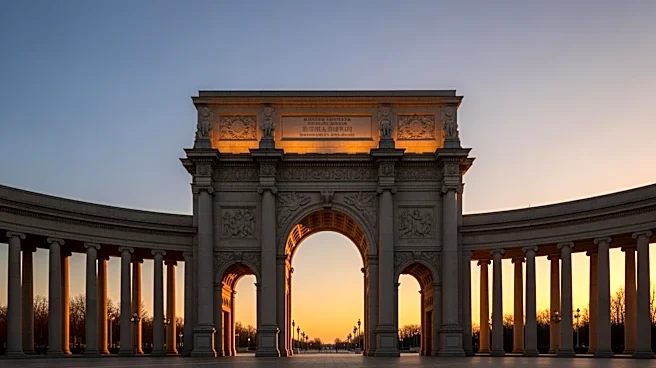
President Trump has unveiled plans for a new triumphal arch in Washington, D.C., which will feature a towering winged figure reminiscent of Lady Liberty, flanked by eagles and guarded by lions, all gilded.
The arch is planned to stand 250 feet tall and will be inscribed with 'One Nation Under God' and 'Liberty and Justice for All.' The structure is intended to be built between the Lincoln Memorial and Arlington National Cemetery, within a traffic circle connecting Washington with northern Virginia. Trump has expressed that the capital has long needed such a monument, citing historical attempts to build one that were interrupted by the Civil War and other events. This arch is part of several architectural changes Trump is implementing during his second term, including modifications to the White House.
Why It's Important?
The proposed arch represents President Trump's ambition to leave a lasting legacy in Washington, D.C., through monumental architecture. It reflects his vision of enhancing the capital's aesthetic and historical significance. The arch could become a new symbol of national pride and unity, potentially attracting tourism and influencing the cultural landscape of the city. However, it may also spark debates over the allocation of resources and the prioritization of such projects amidst other national concerns. The initiative underscores Trump's focus on grand architectural projects as a means of cementing his influence and vision for the nation's capital.
What's Next?
The next steps involve securing approval from relevant authorities, including the U.S. Commission on Fine Arts, and addressing any logistical or financial challenges associated with the construction of the arch. Public and political reactions are likely to emerge, with discussions on the project's feasibility, cost, and impact on the surrounding area. Stakeholders, including local government and community groups, may weigh in on the proposal, influencing its progression. The project could also face scrutiny regarding its alignment with broader urban planning and historical preservation efforts in Washington, D.C.