








What's Happening?
The Philippines is increasingly adopting a public strategy to challenge China's maritime claims in the South China Sea. This approach was recently exemplified at the Seoul Defense Dialogue, where Philippine Defense Secretary Gilberto Teodoro Jr. publicly
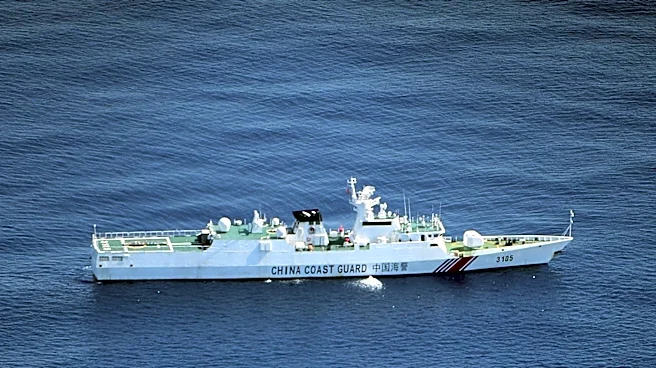
read and refuted Chinese positions on disputed issues, rather than engaging in private diplomatic communication. This action highlights Manila's growing willingness to internationalize the dispute and frame it before a global audience, emphasizing international law and alliances. The disputes, which involve reefs, maritime boundaries, fishing rights, and freedom of navigation, have led to escalating confrontations between Philippine and Chinese vessels. China, in response, has intensified its 'gray-zone' operations, utilizing coast guard vessels and other non-military assets to assert its presence and claims, particularly around areas like Scarborough Shoal and near Taiwan. These actions are seen as an attempt to normalize a sustained Chinese presence in disputed waters and collect operational data.
Why It's Important?
This shift in the Philippines' strategy has significant implications for regional security and U.S. foreign policy. By publicly contesting China's claims, Manila is transforming the South China Sea dispute from a bilateral issue into a broader international concern, potentially drawing in more global attention and support. The strategic backdrop includes the Mutual Defense Treaty between the Philippines and the United States, which Washington has repeatedly affirmed applies to attacks on Philippine armed forces, public vessels, and aircraft in the South China Sea. An escalation involving Philippine and Chinese forces could therefore implicate U.S. treaty commitments, potentially transforming a maritime encounter into a larger strategic crisis. For Beijing, assertive actions against its Southeast Asian neighbors risk pushing these countries to deepen defense relationships with the United States and other regional powers, counteracting China's efforts to expand its influence.
What's Next?
The Philippines is expected to continue its strategy of internationalizing the South China Sea disputes, seeking to garner further international support and diplomatic pressure against China's claims. This may involve more public condemnations of Chinese actions and increased engagement with allies and partners. China is likely to persist with its 'gray-zone' tactics and maritime activities to assert its sovereignty, potentially leading to further confrontations. Managing escalation will be a critical challenge for all parties involved, particularly for the United States, which must balance its treaty obligations with the need to prevent a wider conflict. The international community will closely watch how these public challenges and responses unfold, as they could set precedents for resolving similar territorial disputes globally.
Beyond the Headlines
The public nature of the Philippines' challenge introduces a new dimension to the South China Sea dispute, moving beyond traditional diplomatic channels to a battle for international public opinion and legitimacy. This approach leverages the power of transparency and international law to counter China's more opaque and assertive tactics. It also highlights the growing importance of alliances and multilateral cooperation in addressing complex geopolitical challenges. The long-term implications could include a re-evaluation of international maritime law enforcement and defense strategies in the Indo-Pacific. Furthermore, the increased 'gray-zone' operations by China blur the lines between civilian and military activities, posing ethical and legal dilemmas regarding rules of engagement and the definition of aggression in international waters. This could lead to a redefinition of what constitutes a 'provocation' and how nations respond to non-military assertions of sovereignty.