


What's Happening?
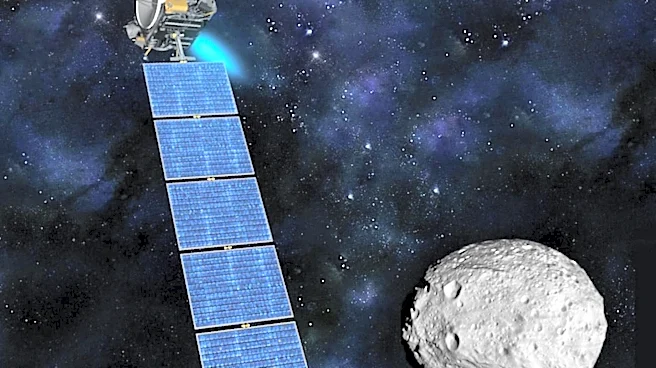
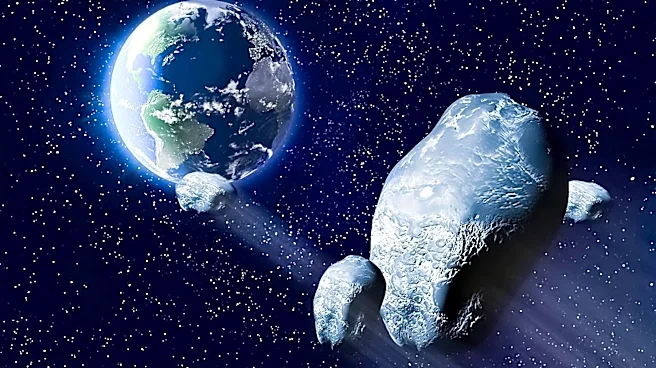
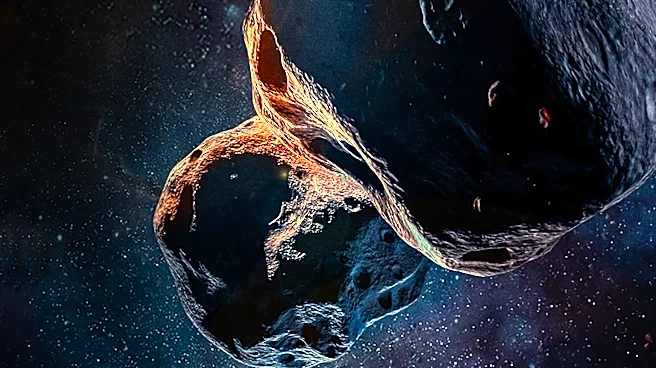
The Japan Aerospace Exploration Agency (JAXA) has successfully captured an image of a two-headed asteroid named Torifune, located 62 million miles from Earth. The image was taken by the Hayabusa2 probe during a close flyby, which brought the spacecraft
within six miles of the asteroid. Torifune, measuring 1,475 feet in length, was photographed using the probe's Optical Navigation Camera and Thermal InfraRed Imager. The asteroid orbits the Sun every 383 days and is classified as a near-Earth object. The mission aims to gather data on the asteroid's composition and structure, contributing to the understanding of such celestial bodies.
Why It's Important?
The successful imaging of Torifune by JAXA's Hayabusa2 probe is a significant achievement in space exploration, providing valuable data on the characteristics of near-Earth asteroids. Understanding the composition and behavior of these asteroids is crucial for assessing potential threats to Earth and developing strategies for planetary defense. Additionally, the mission contributes to the broader scientific knowledge of the solar system's formation and evolution. The data collected could also inform future missions aimed at asteroid mining, which has potential economic implications.
What's Next?
JAXA plans to continue analyzing the data collected from the Torifune flyby, with further transmissions expected as the probe continues its mission. The Hayabusa2 is also scheduled to visit another asteroid, 1998 KY26, to gather more information on smaller celestial bodies. These missions will enhance the understanding of asteroid dynamics and composition, potentially leading to new discoveries about the solar system. The ongoing research may also influence future space exploration strategies and the development of technologies for asteroid interaction.