




What's Happening?
Scientists are increasingly looking to volcanic eruptions as natural analogs to study solar geoengineering, specifically stratospheric aerosol injection (SAI). This approach involves releasing sulfur dioxide or other aerosol precursors into the stratosphere
to reflect sunlight and cool the Earth, mimicking the effects of large volcanic eruptions like Mount Pinatubo in 1991. That eruption released nearly 20 million tons of sulfur dioxide, causing global temperatures to drop by about one degree Fahrenheit for two years. Researchers like Matthew Watson from the University of Bristol are developing high-altitude drones to fly into volcanic plumes to gather data on how volcanic aerosols form and evolve. This research aims to understand the potential climatic effects of SAI, which has faced significant political and public resistance, hindering controlled field trials. For instance, the Stratospheric Controlled Perturbation Experiment (SCoPEx) by Harvard University was canceled due to opposition from environmental and Indigenous groups, and some U.S. states have passed laws prohibiting intentional atmospheric releases. Scientists hope that studying natural eruptions can provide crucial data that controlled experiments currently cannot.
Why It's Important?
The reliance on volcanic eruptions for solar geoengineering research highlights the significant societal and political hurdles facing direct climate intervention experiments. Public and political resistance stems from concerns about unintended consequences, such as altered regional rainfall patterns and potential weakening of monsoons in Asia and Africa. Critics also argue that geoengineering research distracts from essential emission reduction efforts and could be exploited by fossil-fuel interests. The inability to conduct controlled outdoor tests means that scientists are missing critical data to assess the efficacy and risks of these technologies accurately. This situation forces researchers to wait for unpredictable natural events, slowing down the scientific understanding of potential climate solutions. The ethical and governance implications of deliberately altering the Earth's climate are profound, and without comprehensive data, informed decisions about such interventions remain challenging. The ongoing debate underscores the tension between the urgent need for climate solutions and the cautious approach required for technologies with potentially global impacts.
What's Next?
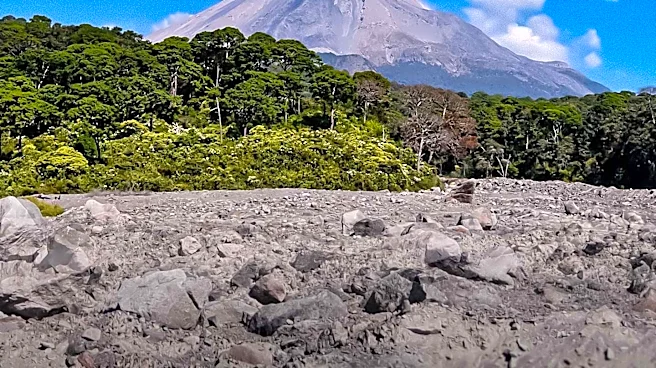
Researchers plan to deploy drones to active volcanoes in Guatemala, Montserrat, and Chile by 2027 to study frequent eruptions and passive degassing, which can alter cloud microphysics. This will provide data relevant to both SAI and marine cloud brightening, another solar geoengineering approach. The ultimate goal is to establish a rapid drone-response system capable of deploying nine aircraft swiftly to the next large volcanic eruption worldwide, ensuring that such a natural experiment is not missed. Organizations like the Volcano Response initiative (VolRes) are already preparing for rapid data collection from future large eruptions, having mobilized for events like Russia's Raikoke volcano in 2019 and the Hunga Tonga-Hunga Ha'apai eruption in 2022. Continued research will also involve analyzing past eruptions, like Pinatubo and Raikoke, to understand how factors like a volcano's location and plume height affect global cooling and side effects. The scientific community will continue to prepare for the next significant eruption, viewing it as an invaluable opportunity to advance understanding of solar geoengineering.
Beyond the Headlines
The controversy surrounding solar geoengineering extends beyond scientific uncertainty to deep ethical and societal questions. The historical impacts of volcanic cooling, such as famines and disease outbreaks following eruptions like Laki in 1783 and Tambora in 1815, serve as stark reminders of the potential for unintended consequences when altering global climate systems. Any deliberate attempt to mimic these effects inherits this complex history, raising concerns about who decides to implement such technologies, who bears the risks, and how potential harms are mitigated. Public perception, often influenced by a lack of awareness, as observed in the Philippines, highlights the need for broader public engagement and education on climate engineering. The struggle to gain social buy-in for field trials underscores a fundamental challenge: balancing scientific advancement with public trust and ethical considerations. This situation necessitates robust governance frameworks and international cooperation to ensure that any future climate interventions are developed and deployed responsibly, with equitable consideration for all global communities.