






What's Happening?
The U.S. Navy has awarded multinational defense giant BAE Systems a contract worth approximately $137.66 million to manufacture new pump-jet propulsor assemblies for its Virginia-class nuclear-powered attack submarines (SSNs). The Naval Surface Warfare
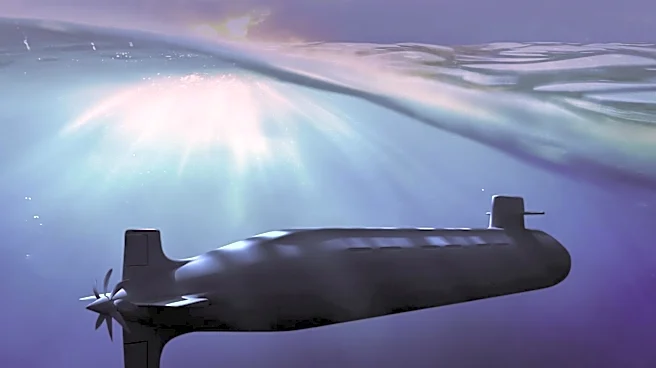
Center Carderock Division is identified as the contracting organization. This contract covers production, engineering services, replacement parts, and associated support, with an ordering period extending through September 2032. Virginia-class submarines utilize pump-jets instead of conventional screw propellers, which are designed to be quieter and harder for adversaries to detect. These propulsors incorporate a rotor and stationary flow-conditioning components within a surrounding duct or shroud, managing water flow to reduce cavitation and improve acoustic performance. Precision manufacturing is critical for these components, as any imperfection can create vibrations and unwanted acoustic signatures that compromise detection advantages. BAE Systems, which has previously delivered major propulsor assemblies for every Virginia-class submarine built to date, has manufacturing and engineering operations in Kentucky, Florida, and Minnesota.
Why It's Important?
This contract is crucial for the U.S. Navy's efforts to maintain and accelerate its submarine production cadence, particularly for the Virginia-class SSNs, which are central to American undersea warfare. These submarines perform vital intelligence collection, anti-submarine warfare, anti-surface warfare, and land-attack missions. The reliable delivery of specialized propulsion components is essential for increasing construction rates, especially as the Navy aims for a '1+2' production cadence—one Columbia-class and two Virginia-class submarines annually. In recent years, Virginia-class production has faced shortfalls due to skilled labor shortages, supplier constraints, and shipyard capacity problems. By securing this contract, the Navy aims to ensure a dependable domestic supplier base for these long-lead components, which are critical for final submarine assembly. This is particularly important in the context of increasing undersea competition with China, as the Virginia-class submarines, especially the Block V variants with the Virginia Payload Module, enhance strike capacity and help address the missile gap.
What's Next?
The contract with BAE Systems extends through September 2032, ensuring a steady supply of critical propulsor assemblies for the Virginia-class submarines over the next decade. This long-term commitment is expected to help the Navy improve its production cadence for Virginia-class boats, addressing past shortfalls caused by supply chain issues. BAE Systems has stated its commitment to meeting the Navy's target of two Virginia-class propulsor sets annually and has invested its own capital in facilities and workforce development to support this goal. The continued development and deployment of advanced Virginia-class submarines, including those equipped with the Virginia Payload Module, will be a key focus for the U.S. Navy in maintaining its undersea dominance and strategic deterrence capabilities. The Navy will also continue its efforts to replace aging Los Angeles-class submarines with the more advanced Virginia-class vessels.
Beyond the Headlines
The emphasis on pump-jet technology highlights the ongoing arms race in stealth capabilities in undersea warfare. The quietness of these propulsion systems is a critical factor in modern submarine operations, where detecting an opponent before being detected is paramount. This contract also underscores the broader challenges in defense manufacturing, including the need for a robust and specialized industrial base to support complex military programs. The reliance on a single company, BAE Systems, for such a critical component also points to the specialized nature of this technology and the potential vulnerabilities if that supply chain were disrupted. Furthermore, the Navy's struggle to meet production targets for Virginia-class submarines, despite significant investment, reflects systemic issues within the defense industrial complex, such as labor shortages and capacity constraints, which have wider implications for national security and economic stability. The strategic importance of these submarines in countering rising naval powers like China and Russia will continue to drive investment and innovation in this sector.