



What's Happening?
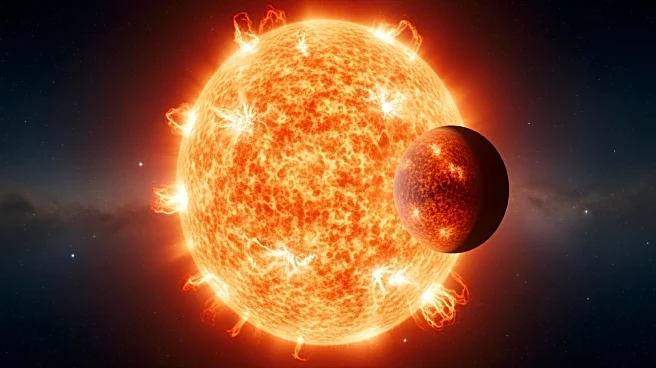
New research indicates that aging Sun-like stars may lose their closest planets as they evolve. Using data from NASA's Transiting Exoplanet Survey Satellite (TESS), scientists found that planets in short, close orbits are less common around older stars.
As stars expand, they can pull nearby planets inward through tidal forces or engulf them entirely. The study, which analyzed nearly 457,000 post-main-sequence stars, suggests that planetary loss is a common outcome of stellar aging. This research provides insights into how planetary systems change over time and the long-term future of solar systems similar to our own.
Why It's Important?
The findings improve our understanding of the interactions between stars and planets as stars evolve. By identifying the mechanisms behind planetary loss, the research offers a framework for studying the future of solar systems, including our own. This knowledge is crucial for predicting the fate of Earth and other planets as the Sun ages. The study also highlights the challenges of detecting planets around older stars, as larger stars produce weaker transit signals. The results emphasize the importance of stellar mass in predicting how stars evolve and the potential for planetary loss.
What's Next?
Future observations and missions, such as the European Space Agency's Plato mission, will provide additional data to refine our understanding of planetary loss around aging stars. Researchers will continue to study the influence of factors like metallicity and stellar dynamics on planetary formation and survival. The findings may also prompt the development of new models to predict the long-term evolution of planetary systems. As more data becomes available, scientists will work to identify other systems where planetary loss is occurring and explore the implications for habitability and the search for life beyond Earth.