






What's Happening?
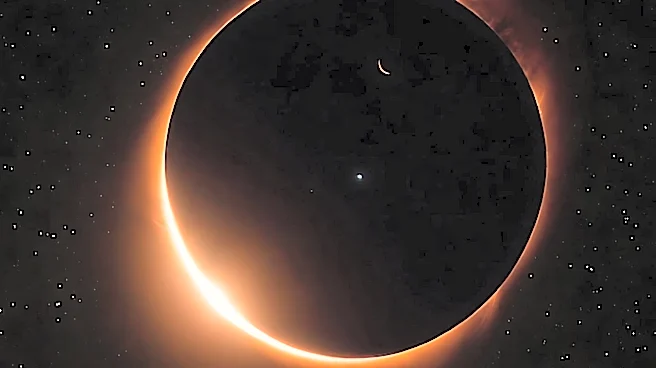
NASA has announced that it will provide a live stream of the total solar eclipse occurring on August 12, 2026. This celestial event will be visible along a narrow path that includes Greenland, Iceland, northern Russia, the Atlantic Ocean, Spain, and a small
part of Portugal. The live stream is set to begin at 1:15 p.m. ET, allowing viewers worldwide to witness the Moon fully blocking the Sun. The path of totality will offer maximum eclipse duration of 2 minutes and 18 seconds over the North Atlantic. In the U.S., only parts of the northern states will experience a partial eclipse, with Texas and the Dallas-Fort Worth area outside the visibility zone. The last total solar eclipse visible from Earth occurred on April 8, 2024, and the next one is scheduled for August 2, 2027.
Why It's Important?
The live streaming of the solar eclipse by NASA is significant as it democratizes access to a rare astronomical event, allowing people who are not in the path of totality to experience it virtually. This initiative highlights the role of technology in enhancing public engagement with science and astronomy. For educational institutions and enthusiasts, the event provides a unique opportunity to study and appreciate the dynamics of solar eclipses. The eclipse also serves as a reminder of the intricate celestial mechanics that govern our solar system, fostering a broader interest in space exploration and science.
What's Next?
Following the August 12 eclipse, the next total solar eclipse will occur on August 2, 2027, with its path crossing southern Spain, North Africa, and parts of the Middle East. NASA's continued efforts to provide live coverage of such events will likely enhance public interest and participation in future astronomical phenomena. Additionally, the advancements in streaming technology may lead to more interactive and immersive viewing experiences for global audiences.