






What's Happening?
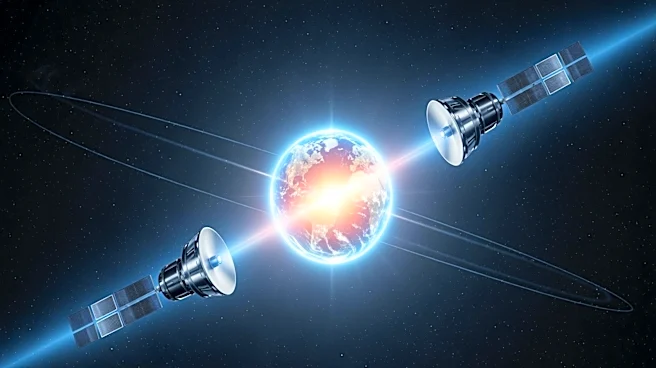
The upcoming World Radiocommunication Conference 2027 (WRC-27) in Shanghai is set to become a significant arena for U.S.-China competition in space. China has filed for 200,000 additional satellites, aiming to lead in low Earth orbit satellite constellations
and electronic warfare. The conference will address critical issues such as spectrum allocations for satellite communications, which are vital for both national security and the space economy. The U.S. currently leads with Starlink's extensive satellite network, but China's rapid advancements pose a challenge. The Federal Communications Commission (FCC) is actively working on regulatory frameworks to maintain U.S. leadership in space technology.
Why It's Important?
The outcomes of WRC-27 will have far-reaching implications for global space policy and the balance of power in space technology. The U.S. aims to secure its leadership position by influencing international regulations that support its technological advancements. The conference will address key issues like direct-to-device spectrum and power levels for non-geostationary orbit satellites, which are crucial for the U.S. space industry's growth. The decisions made could impact the U.S.'s ability to bridge the digital divide and maintain its competitive edge against China's growing space ambitions.
What's Next?
In preparation for WRC-27, the U.S. government and industry stakeholders must collaborate to finalize strategic positions and studies. The FCC is expected to continue updating its regulations to align with international standards. Diplomatic efforts will be crucial, with the State Department working alongside the FCC to promote U.S. approaches globally. An international spectrum summit in the U.S. could help coordinate strategies with allies. The conference's outcomes will shape the future of space exploration and technology, making it imperative for the U.S. to lead in setting the rules.