







What's Happening?
IBM, in collaboration with the U.S. Department of Energy-funded Quantum Science Center (QSC) at Oak Ridge National Laboratory (ORNL) and AMD, has unveiled a new co-design platform for quantum error correction. This initiative integrates quantum and high-performance
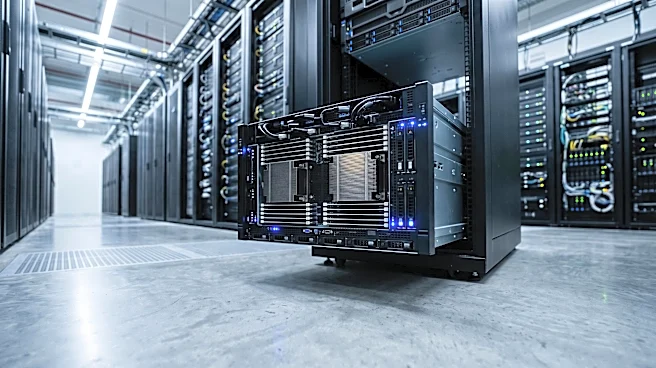
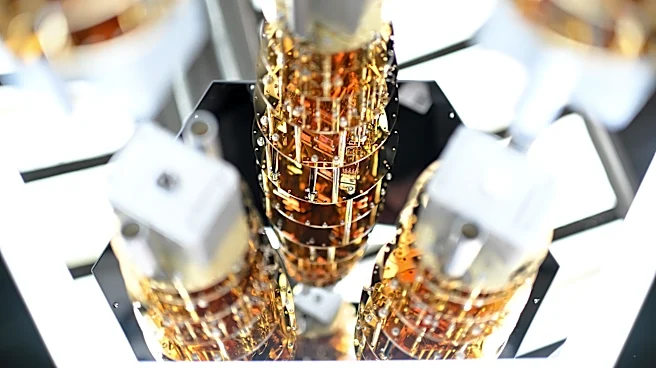
computing to accelerate the development of a scientifically relevant quantum computer by 2028, aligning with the DOE's Quantum Genesis Mission. The platform co-locates IBM's quantum computers, including the 120-qubit IBM Quantum Nighthawk processor, with ORNL's Umbra High-Performance Computing (HPC) system. The Umbra system is powered by AMD Instinct MI355X GPUs and 5th Gen AMD EPYC CPUs, providing the classical computing foundation for research into quantum error correction, decoding optimization, and software orchestration. This collaboration aims to address the challenge of scaling quantum error correction by tightly integrating classical and quantum computing resources.
Why It's Important?
This collaboration is crucial for advancing quantum computing in the U.S. by tackling quantum error correction, a significant hurdle to developing practical quantum computers. By combining IBM's quantum hardware with ORNL's HPC capabilities and AMD's classical computing power, the initiative seeks to accelerate progress toward fault-tolerant quantum computing. The Department of Energy's Quantum Genesis Mission, which targets 100 logical qubits running 100,000 hard operations by late 2028, underscores the national strategic importance of this research. Success in this area could lead to breakthroughs in scientific discovery, impacting various sectors from materials science to drug development. The integration of quantum, AI, and high-performance computing could redefine computational capabilities, offering a competitive edge for U.S. research and industry.
What's Next?
The co-design platform will enable researchers to evaluate different architectures, software, and workflows for quantum error correction, aiming to scale these advances. The insights gained will inform IBM's path toward its first fault-tolerant quantum computer, IBM Quantum Starling, and future Super Intelligence (SI) + HPC supercomputers. The effort will also explore how future generations of AMD compute, networking, and open software can evolve alongside quantum computers. DOE researchers are expected to utilize these advancements immediately. The project will continue to develop error correction methods that accelerate progress toward the Quantum Genesis Mission's 2028 goal, focusing on workflows that combine quantum processors with high-performance classical computing for error correction.
Beyond the Headlines
The establishment of this co-design platform highlights a broader trend of increasing collaboration between government research institutions and private technology companies in critical scientific fields. This partnership not only addresses technical challenges in quantum computing but also sets a precedent for how complex, multi-disciplinary research can be structured. The focus on quantum error correction, a foundational element for reliable quantum computing, suggests a long-term vision for quantum technology beyond current noisy intermediate-scale quantum (NISQ) devices. The integration of quantum with AI and HPC also points to a future where these advanced computing paradigms are not isolated but work synergistically, potentially leading to entirely new computational capabilities and applications across various scientific and industrial domains.