




What's Happening?
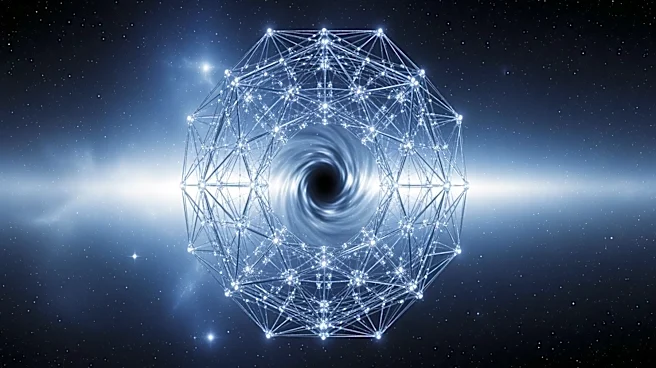
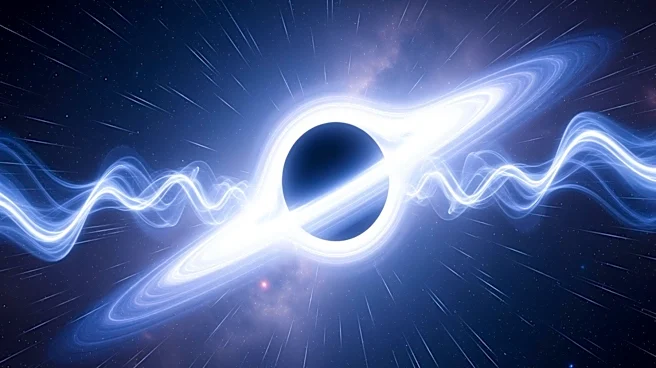
A new theoretical study has provided support for the concept that mathematical patterns of ripples in space-time geometry, known as space-time crystals, could give rise to naked singularities and microscopic black holes. This research builds on the work
of physicist Matthew Choptuik, who in 1993 demonstrated how naked singularities could hypothetically occur under specific conditions. These singularities differ from black holes as they lack an event horizon, making them potentially observable. The study, published in Physical Review Letters, describes the formation of these space-time crystals using mathematical methods, offering a precise depiction of how such phenomena could exist. The research team, including Christian Ecker and Daniel Grumiller, utilized advanced mathematical techniques to explore these possibilities, although the existence of such states remains theoretical.
Why It's Important?
The study's findings are significant as they challenge long-standing assumptions in theoretical physics about the nature of singularities and black holes. By suggesting that naked singularities could exist, the research opens new avenues for understanding the fundamental laws of physics and the universe's structure. This could have profound implications for astrophysics and cosmology, potentially altering how scientists perceive gravitational collapse and the behavior of matter under extreme conditions. The possibility of observing naked singularities could also lead to new experimental approaches in physics, providing insights into phenomena that were previously considered beyond the reach of observation.
What's Next?
Future research will likely focus on bridging the gap between theoretical predictions and numerical simulations to further validate the existence of space-time crystals and naked singularities. The research team plans to extend their numerical methods to higher dimensions, which could provide a more comprehensive understanding of these phenomena. If successful, this could lead to a more unified theory of gravity and quantum mechanics, addressing some of the most challenging questions in modern physics. Additionally, observational efforts may be directed towards identifying potential signatures of naked singularities in the universe.
Beyond the Headlines
The implications of this study extend beyond theoretical physics, touching on philosophical questions about the nature of reality and the limits of human knowledge. The concept of naked singularities challenges the notion of causality and determinism, as these objects could theoretically allow for information to escape from regions of space-time that were previously thought to be isolated. This raises ethical and philosophical considerations about the pursuit of knowledge and the potential consequences of uncovering new aspects of the universe that could fundamentally alter our understanding of existence.