



What's Happening?
Following his re-election in late 2024, President Trump began to provoke Canada by referring to it as the '51st American state' and posting a map on Truth Social depicting Canada as part of the United States. He also taunted Canadian Prime Minister Justin
Trudeau by calling him 'Governor Trudeau.' This rhetoric escalated, with President Trump stating that Canada could retain 'O, Canada' as its anthem, but 'it’ll be for the state.' In response, Mark Carney, who replaced Trudeau as the leader of the Liberal Party, firmly stated, 'America is not Canada, and Canada never, ever will be part of America in any way, shape, or form.' This strong stance resonated with Canadians, leading to a significant election victory for Carney and the Liberal Party. President Trump's actions are rooted in his belief that the U.S. should dominate the Western Hemisphere and that the U.S. economy gives it leverage over Canada, as the U.S. is the primary purchaser of Canadian exports. In August, dissatisfied with Canada's response to his trade demands, President Trump imposed a 50 percent tariff on Canadian imports into the United States, complaining that Canada 'wants the benefits of being a State, without being one.' Carney reiterated his commitment to resisting these pressures, stating, 'Last spring, I warned that America is trying to break us so that they can own us. And promised: 'That will never, ever happen.' We are keeping that promise.' Polling indicated that three-quarters of Canadians supported Carney's position, with even conservative leaders like Doug Ford, Premier of Ontario, expressing full support and defiance against President Trump's actions.
Why It's Important?
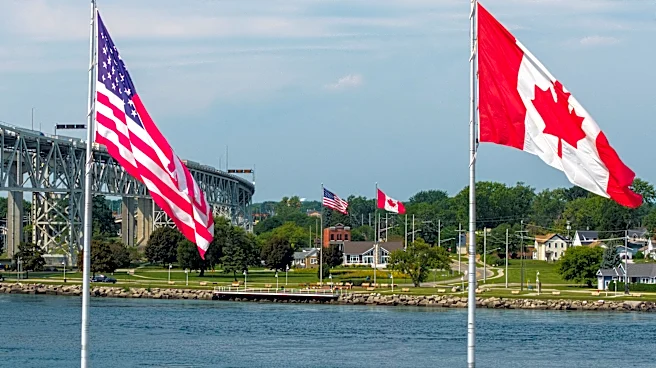
This deterioration of U.S.-Canada relations is significant because it undermines a historically strong and peaceful bilateral relationship, characterized by the world's longest undefended border and close defense partnerships through NATO. The imposition of tariffs by President Trump on Canadian imports directly impacts economic ties, potentially leading to increased costs for consumers, reduced trade volumes, and economic instability for businesses reliant on cross-border commerce. The rhetoric employed by President Trump, suggesting Canadian statehood, challenges Canada's national sovereignty and identity, which can have profound political and social ramifications. The strong Canadian public and political response, including the electoral shift towards Carney, demonstrates the deep national sentiment against perceived American dominance. This situation highlights how political leadership and rhetoric can quickly strain long-standing international alliances, affecting not only trade but also diplomatic trust and cooperation on broader global issues. The economic implications for both nations, particularly for Canadian industries heavily dependent on the U.S. market, are substantial, potentially forcing a re-evaluation of trade strategies and diversification of economic partnerships.
What's Next?
The immediate future of U.S.-Canada relations will likely remain tense as long as President Trump's policies and rhetoric persist. The tariffs imposed on Canadian imports will continue to affect trade, and Canada may explore retaliatory measures or seek alternative markets for its goods. The upcoming November 2026 U.S. Congressional elections could be a pivotal moment, as a significant repudiation of President Trump's political approach might lead to a shift in U.S. foreign policy towards Canada. Alternatively, President Trump's departure from public office or a sudden shift in his focus to other issues could also de-escalate the situation. However, the ease with which the relationship has been damaged suggests that even with a change in leadership, rebuilding trust and cooperation will require concerted diplomatic efforts. Both nations will need to navigate the economic consequences of the tariffs and the political fallout from the strained relationship, potentially impacting future collaborations on security, environmental, and social issues.
Beyond the Headlines
The current crisis in U.S.-Canadian relations reveals a deeper fragility in international relations, demonstrating how the actions and rhetoric of individual leaders can disrupt centuries of cooperation. This situation underscores the importance of international law and institutions in providing a stable framework for resolving disputes and fostering cooperation. The article suggests that strengthening institutions like the United Nations and the International Court of Justice could offer a more rational and effective way to handle international disagreements, rather than relying on the whims of national rulers. The incident also highlights the psychological impact of political rhetoric on national identity and pride, as seen in the strong Canadian reaction to President Trump's '51st state' comments. This episode could serve as a case study for the need to reinforce diplomatic norms and multilateral approaches to global challenges, emphasizing that even the most amicable relationships are not immune to political volatility.