





What's Happening?
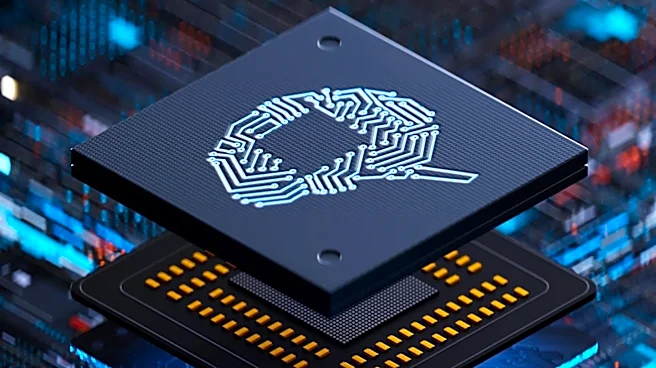
Researchers from Rutgers, IBM, and collaborating institutions have demonstrated a significant advancement in quantum computing by enabling a quantum computer to monitor and correct its own errors in real-time. This experiment, conducted on a 156-qubit
IBM Quantum Heron processor, involved programming the system to alternate between 'scrambler' tasks, which introduce chaos, and 'reset' tasks, which check and correct individual qubits. The team successfully performed nearly 5,000 operations linking pairs of qubits and an equal number of checks and resets, marking the largest successful demonstration of this approach to date. This capability is crucial for developing fault-tolerant quantum computers, which can maintain accurate computations despite the inherent fragility and error-proneness of qubits. The study also confirmed a theoretical prediction, showing that as the frequency of checks and resets increased, the system abruptly shifted from a chaotic state to a controllable, orderly one, akin to a phase transition in physics.
Why It's Important?
This breakthrough is a critical step toward building larger, more reliable quantum computers that can solve problems currently beyond the reach of conventional machines. The ability of quantum computers to self-correct errors addresses a major bottleneck in their development. Qubits, unlike classical bits, are highly sensitive to external factors like heat and electromagnetic signals, leading to rapid error accumulation. Without effective error correction, quantum calculations quickly become unreliable. By demonstrating repeated, real-time error correction, this research paves the way for fault-tolerant quantum computers, which are essential for practical applications in various fields. These include designing better batteries, developing cleaner industrial catalysts, simulating complex molecules and materials, and running advanced artificial intelligence programs. The transition from chaotic to controlled behavior observed in the experiment also provides valuable insights into quantum mechanics, potentially influencing future theoretical developments and hardware designs.
What's Next?
The immediate next step for researchers will likely involve further refining the error correction protocols and scaling up the number of qubits in self-correcting systems. The current demonstration, while significant, is a foundational step, and the goal is to achieve continuous, robust fault tolerance across even larger quantum processors. This will involve optimizing the balance between error-inducing and error-correcting operations to maintain system stability and accuracy. Additionally, the insights gained from observing the phase transition from chaos to control could lead to new strategies for managing quantum systems. The collaboration between academic institutions like Rutgers and industry leaders like IBM suggests a continued push towards practical quantum computing solutions. Future research will also focus on integrating these error correction capabilities into diverse quantum computing architectures, moving closer to the realization of truly fault-tolerant quantum computers capable of tackling real-world, complex computational challenges.
Beyond the Headlines
The development of self-correcting quantum computers has profound implications beyond immediate computational power. Ethically, it raises questions about the responsible development and deployment of such powerful technology, particularly concerning data security and potential societal impacts. Legally, as quantum computing advances, new frameworks may be needed to address intellectual property, data ownership, and the implications of quantum-resistant cryptography. Culturally, the ability to simulate complex natural processes with unprecedented accuracy could revolutionize scientific understanding across disciplines, from materials science to medicine, potentially leading to new discoveries and technologies that reshape human life. The shift from theoretical understanding to practical implementation of quantum error correction also signifies a maturation of the field, moving it closer to a point where quantum computing could transition from a specialized research area to a transformative general-purpose technology, impacting industries and daily life in ways yet to be fully imagined.