
What's Happening?
A recent report on the state of human rights and governance in Kenya indicates a significant democratic backsliding, with citizens facing increased state crime, economic hardship, and governance failures.
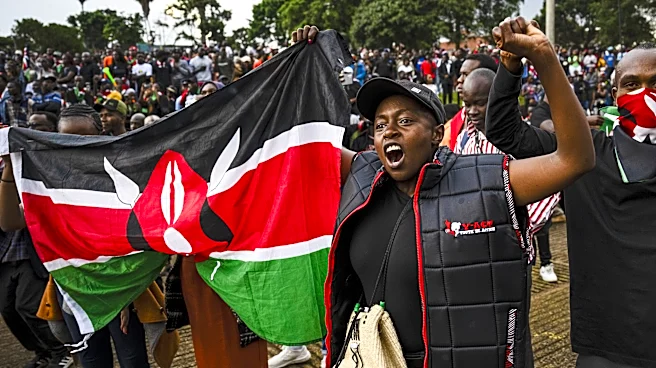
The report, a content analysis of independent and media reports from September 2025 to October 2026, highlights a pattern of state response to protests with brute force, surveillance, arrests, and restrictions on civic space. Freedom House downgraded Kenya's global freedom score from 51 to 49 out of 100, classifying it as 'partly free,' while CIVICUS rated the country as 'repressed.' Amnesty International noted a deterioration in human rights, citing unlawful force during demonstrations, enforced disappearances, arbitrary arrests, and intimidation of journalists and activists. Land, climate, and natural resource disputes have also emerged as critical human rights issues, with concerns raised by UN special procedures regarding fossil fuel extraction in Turkana without the free, prior, and informed consent of indigenous peoples.
Why It's Important?
This comprehensive report underscores a concerning trend of diminishing democratic practices and escalating human rights violations in Kenya as the country approaches the 2027 general election. The documented abuses, including police brutality, political violence, and restrictions on fundamental freedoms, create a volatile environment that could jeopardize the integrity of future elections and further destabilize the nation. The report's findings suggest a systemic weakening of oversight institutions, such as Parliament, and a failure of accountability mechanisms, allowing perpetrators of violence and corruption to operate with impunity. The impact extends to economic and social rights, with education and healthcare becoming less accessible and affordable, disproportionately affecting vulnerable populations. This erosion of human rights and democratic principles not only harms Kenyan citizens but also sets a dangerous precedent for the region, potentially inspiring similar authoritarian tactics in neighboring countries.
What's Next?
The report outlines ten 'irreducible demands' for the state to address the deteriorating human rights situation. These include ending police killings, torture, and arbitrary arrests; protecting peaceful assembly; safeguarding journalists and human rights defenders; protecting digital rights; ensuring credible electoral preparations; preventing political intolerance; ending grand corruption; accounting for public debt and taxes; ensuring affordable education and health; and protecting land, environmental, and community rights. Independent institutions like the Independent Policing Oversight Authority (IPOA), the Kenya National Commission on Human Rights (KNCHR), and the Ethics and Anti-Corruption Commission (EACC) are urged to fulfill their mandates without political interference. The upcoming 2027 general election will be a critical test of the government's commitment to these demands and the resilience of Kenya's democratic institutions. International bodies and civil society groups will likely continue to monitor the situation closely, advocating for accountability and adherence to human rights standards.
Beyond the Headlines
The 'democratic backsliding' described in the report points to a broader struggle between state power and civil liberties. The use of 'transnational repression,' where Kenyan, Tanzanian, and Ugandan agencies coordinate to silence dissent across borders, highlights a regional challenge to human rights. The report also touches on the weaponization of cybercrime laws and surveillance, indicating a growing threat to digital freedoms. The economic context, marked by corruption, punitive taxation, and rising debt, exacerbates social grievances and fuels public discontent, creating fertile ground for protests and further state repression. The findings suggest that without robust independent institutions and a genuine commitment to accountability, the cycle of human rights violations and democratic erosion will continue, with profound long-term consequences for Kenya's stability and its citizens' well-being.