

What's Happening?
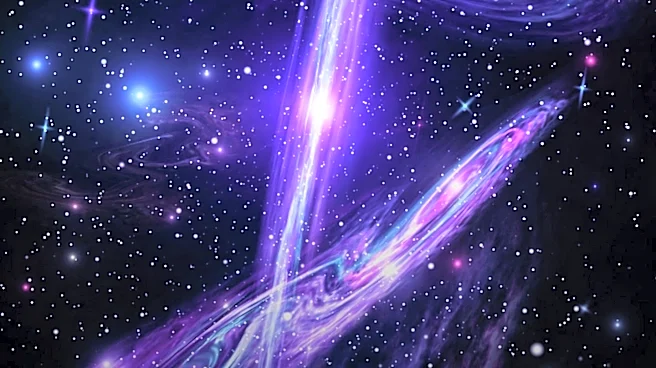
A new study from the University of Washington (UW) has cast doubt on a leading theory regarding the detection of dark matter through observations of stellar streams. Stellar streams are long, thin filaments of stars orbiting galaxies, and their irregularities—such
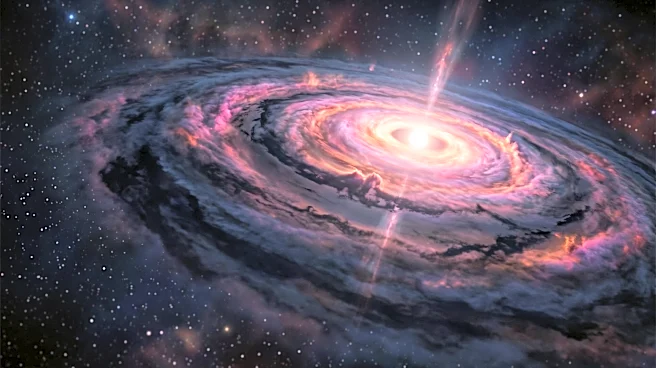
as gaps and kinks—have long been considered potential indicators of gravitational tugs from small clumps of dark matter, known as subhalos. However, UW astronomers, led by postdoctoral scholar Arpit Arora, simulated four Milky Way-sized galaxies without any dark matter clumps, populating them with approximately 15,000 stellar streams. After five billion simulated years, nearly every stellar stream developed irregularities. The study, published in The Astrophysical Journal, suggests that the structure of the host galaxy itself, with its uneven distribution of stars creating areas of varying density, can cause these irregularities as stellar streams pass through denser regions and are bent and torn by the gravitational landscape. This finding indicates that the host galaxy's influence alone can produce the same kinds of irregularities previously attributed to dark matter subhalos.
Why It's Important?
This research significantly impacts the methodology for dark matter detection and understanding the universe's composition. Dark matter constitutes approximately 27% of the universe's mass and is crucial for the formation of cosmic structures, yet its nature remains unknown. If irregularities in stellar streams can be caused by the host galaxy's gravitational environment alone, it complicates the use of stellar streams as a 'sharp tool' for identifying dark matter subhalos. This means that previous interpretations of stellar stream anomalies might need re-evaluation, potentially leading to false positives in the hunt for dark matter. The study highlights the necessity for more refined models that can differentiate between gravitational effects caused by the visible matter distribution within a galaxy and those caused by elusive dark matter. This distinction is vital for accurately constraining dark matter theories and for the success of future observational missions aimed at mapping the universe's dark components.
What's Next?
The UW team plans to incorporate dark matter clumps into their next simulations to determine if they produce distinct stellar stream irregularities that can be differentiated from those caused by the host galaxy. This next step is crucial for developing more precise methods to isolate the gravitational fingerprints of dark matter. Additionally, future observational data from facilities like the Simonyi Survey Telescope at the NSF-DOE Vera C. Rubin Observatory are expected to discover many more stellar streams within our galaxy. This influx of new data will enable astronomers to build a comprehensive taxonomy of stream features, which, combined with the refined simulations, could help identify unique signatures of dark matter. The goal is to move beyond the current ambiguity and establish clearer criteria for identifying dark matter's influence on galactic structures.
Beyond the Headlines
The study underscores the inherent complexities in astrophysical research, particularly when dealing with phenomena that cannot be directly observed. It highlights the iterative nature of scientific discovery, where established theories are continuously tested and refined with new data and computational capabilities. The challenge of distinguishing between the effects of visible matter and dark matter on stellar streams points to a broader theme in cosmology: the difficulty of disentangling various gravitational influences in a dynamic universe. This research also emphasizes the critical role of advanced simulations in modern astronomy, allowing scientists to model complex cosmic processes and test hypotheses that are otherwise impossible to examine directly. The findings will likely spur further theoretical work and observational strategies, pushing the boundaries of our understanding of the fundamental forces and constituents of the cosmos.