



What's Happening?
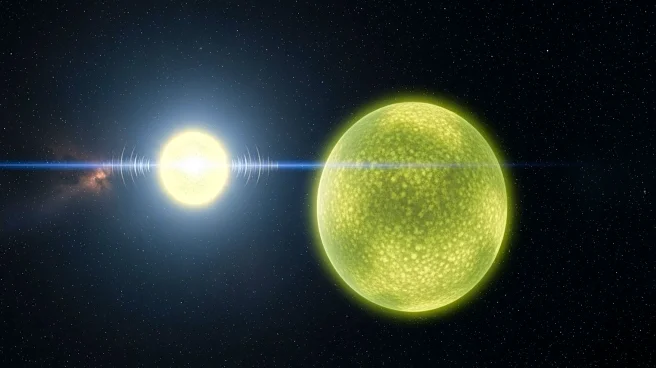
Astronomers using the James Webb Space Telescope have discovered an unusual exoplanet, PSR J2322-2650b, which is being distorted into a lemon shape due to the intense gravitational forces of a nearby pulsar. This planet, roughly the mass of Jupiter, orbits
extremely close to its star, completing a full orbit in just 7.8 Earth hours. The pulsar's gravity stretches the planet into an oblong shape, a phenomenon not previously observed in exoplanets. The planet's atmosphere, composed mainly of helium and carbon, is also unique, with surface temperatures reaching up to 3,700 degrees Fahrenheit. These findings, published in The Astrophysical Journal Letters, suggest the planet might be a new class of cosmic object, possibly a stellar remnant that has lost most of its mass over time.
Why It's Important?
The discovery of PSR J2322-2650b challenges existing theories about planet formation and survival in extreme environments. The planet's unique shape and composition provide new insights into the effects of intense gravitational forces on planetary bodies. This could lead to a better understanding of how planets can exist in close proximity to pulsars, which are typically hostile environments. The findings also open up possibilities for identifying new types of celestial objects, expanding our knowledge of the universe's diversity. This research could influence future studies on the formation and evolution of planets in extreme conditions, potentially impacting our understanding of planetary systems beyond our own.
What's Next?
Further observations and studies are needed to confirm the nature of PSR J2322-2650b and its classification as a new type of cosmic object. Astronomers may use other telescopes and instruments to gather more data on its atmosphere and composition. This could involve looking for similar objects in other parts of the universe to determine if this is a common phenomenon or a unique case. The findings may also prompt theoretical work to develop new models of planet formation and evolution in extreme gravitational environments.