









What's Happening?
The U.S. Navy is grappling with significant capacity constraints in submarine maintenance, repair, and overhaul. To address this, the 350-acre southern peninsula of Mare Island in Vallejo, California, is being strategically repositioned to provide immediate
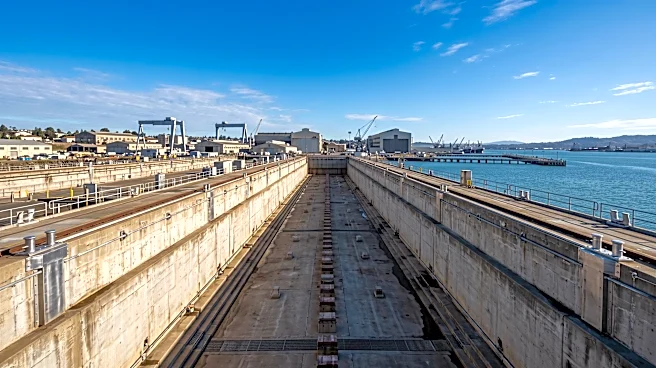
relief for national security and commercial demands. The Nimitz Group, owner of the Mare Island Maritime Campus, has retained JLL to market the property, which includes over 2 million square feet of vacant space, four dry docks, three shipways, a mile of ship berthing, and deepwater channel access. This former naval base, established in 1854 and closed in 1996, also boasts over 30 megawatts of power capacity. JLL's marketing efforts are targeting commercial and naval shipbuilders, defense contractors, maritime operators, and institutional investors, highlighting the site's unique and extensive maritime industrial infrastructure.
Why It's Important?
The repositioning of Mare Island is a critical development for U.S. national security and the maritime industry. The existing capacity constraints in submarine maintenance pose a direct threat to the operational readiness of the U.S. Navy's fleet, which is vital for national defense and global power projection. By offering advanced maritime industrial infrastructure, Mare Island can significantly alleviate these bottlenecks, enabling faster and more efficient maintenance, repair, and overhaul of submarines. This move also supports advanced vessel manufacturing, bolstering the domestic shipbuilding industry and creating high-skilled jobs. The availability of such extensive facilities, which would be prohibitively expensive and time-consuming to replicate, provides a strategic advantage for the U.S. in maintaining its naval superiority and supporting its commercial maritime sector. This initiative could attract substantial investment and foster innovation in maritime technologies.
What's Next?
JLL will continue its marketing and advisory efforts for the Mare Island Maritime Campus, engaging various stakeholders including commercial and naval shipbuilders, defense contractors, maritime operators, and institutional investors. The Nimitz Group is open to different transaction structures, including piecemeal leasing or strategic partnerships, to maximize the site's potential. The goal is to quickly integrate Mare Island's capabilities into the national defense and commercial maritime infrastructure. Potential reactions from major stakeholders will likely include competitive bidding from defense contractors and shipbuilders looking to leverage the site's unique assets. The success of this repositioning will depend on securing the right partners and investments to fully utilize the existing infrastructure for submarine maintenance and advanced vessel manufacturing, thereby addressing the U.S. Navy's critical needs and boosting the domestic maritime industry.
Beyond the Headlines
The revitalization of Mare Island carries deeper implications beyond immediate operational needs. It represents a strategic re-investment in domestic industrial capacity, particularly in a sector critical for national defense. The closure of naval bases like Mare Island in the past led to a decline in specialized maritime skills and infrastructure. This initiative could reverse that trend, fostering a resurgence in skilled labor and technological innovation in shipbuilding and maintenance. Furthermore, it highlights the ongoing challenge of maintaining a robust defense industrial base in an era of evolving geopolitical threats. The project could also serve as a model for repurposing former military assets for dual-use purposes, benefiting both national security and commercial enterprise. The long-term success of Mare Island could influence future policy decisions regarding industrial resilience and strategic infrastructure development.