





What's Happening?
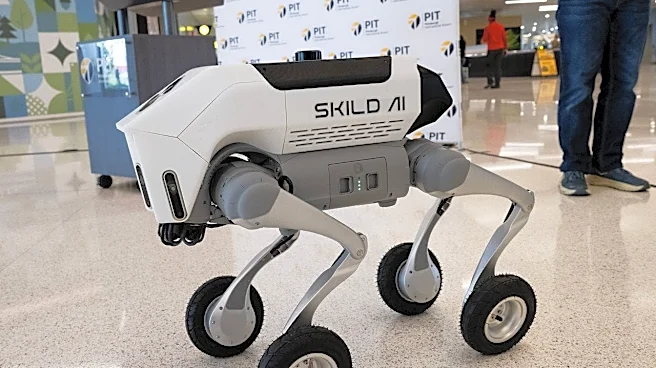
Skild AI has introduced a new self-play training methodology that enables robots to acquire complex physical skills without direct human instruction. Utilizing its S1 robotics foundation model, the company demonstrated this by training a robot to play soccer
through over 140 years of simulated play. The process involved setting a single objective—scoring a goal—and allowing the robot's policy to compete against progressively more advanced versions of itself. This iterative self-improvement led to the development of sophisticated behaviors such as dribbling, tackling, and recovering from falls. The capabilities emerged organically from the primary objective rather than through individually engineered rewards for each specific action. After extensive simulation, the learned policy was successfully transferred to a physical humanoid robot, which then demonstrated its soccer-playing abilities.
Why It's Important?
This advancement in AI and robotics holds significant implications for various U.S. industries and society. By enabling robots to learn complex physical tasks autonomously, the technology could revolutionize sectors like manufacturing, construction, and logistics, where robots could adapt to new environments and tasks more efficiently without extensive human programming. This reduces the bottleneck of human-generated data, which traditionally limits robot capabilities to what humans can demonstrate. The ability for robots to exceed human capability in certain physical tasks through self-play could lead to unprecedented levels of automation and efficiency. Furthermore, the successful transfer from simulation to physical robots, even for a complex task like soccer, suggests a viable path toward more versatile and intelligent robotic systems in real-world applications, potentially impacting job markets and operational costs across industries.
What's Next?
Skild AI plans to extend this self-play approach beyond sports to everyday robotics tasks. The company is also exploring training larger groups of agents, with early experiments in four-agent soccer already showing behaviors like passing and coordination. Future work will focus on collaborative manipulation and navigation as the number of interacting robots increases. This research suggests a future where robots could be deployed in virtual construction sites, factories, or homes, learning and improving their skills over extended periods. The long-term goal is to leverage human data for foundational capabilities and then allow robots to autonomously enhance those capabilities through vast amounts of simulated experience, potentially leading to a significant reduction in the human effort required to teach robots complex behaviors.
Beyond the Headlines
The development of self-play in physical AI raises profound questions about the future of human-robot interaction and the nature of intelligence. If robots can learn and surpass human capabilities in physical tasks, it could redefine the division of labor and the types of skills valued in the workforce. Ethically, it prompts discussions about the autonomy of machines and the extent to which they should be allowed to develop skills independently. Legally, it may necessitate new frameworks for accountability and safety as robots become more self-sufficient. Culturally, the idea of robots learning and evolving without constant human oversight could shift societal perceptions of technology and its role in daily life, potentially leading to a future where robots are not just tools but active, self-improving agents in our physical world.