







What's Happening?
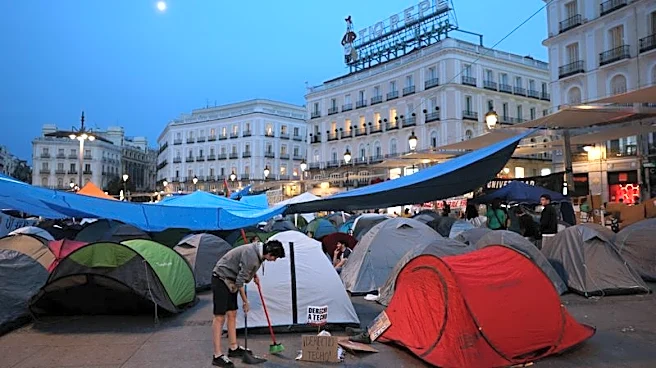
The eviction of 87-year-old Maricarmen Abascal from her Madrid apartment, where she had resided for 70 years, has ignited significant protests across Spain. Tens of thousands marched in Madrid, with many camping overnight in Puerta del Sol, demanding
stronger tenant protections and an end to evictions. Abascal's eviction on September 23, where she was carried out on a stretcher, became a symbol of the country's escalating housing crisis. The Madrid Tenants’ Union, leading the protests, insists on remaining in the plaza until the government enacts new laws, including indefinite rental contracts. This unrest draws parallels to Spain's 2011 'indignados movement,' which also protested economic issues, including evictions, unemployment, and austerity measures. The building where Abascal lived changed ownership in 2018, and an investment fund, Urbagestión, subsequently raised her rent significantly, which she could not afford on her pension.
Why It's Important?
This wave of protests highlights a critical and worsening housing crisis in Spain, where rising costs and a severe housing shortage are pricing many citizens out of the market. Despite strong economic growth, incomes have not kept pace with housing expenses, exacerbated by tourism and immigration-driven population growth in major cities like Madrid, Barcelona, and Valencia. The Bank of Spain estimated a shortage of approximately 550,000 homes last year. The situation is further compounded by Spain's low ranking in subsidized public rental housing within the Organization for Economic Co-operation and Development, with less than 2% of its housing stock being public rental, compared to an 8% EU average. The public outrage, fueled by cases like Abascal's, underscores a growing social and economic divide, potentially leading to significant policy shifts in tenant rights and housing regulations.
What's Next?
Spain's Socialist-led government is anticipated to announce new measures concerning the housing crisis in its upcoming weekly cabinet meeting. Prime Minister Pedro Sánchez has directly addressed Abascal, stating that the government is working on a Royal Decree on housing and urging parliamentary groups to validate it. Protesters, led by the Madrid Tenants’ Union, have vowed to continue their encampment in Puerta del Sol until new laws, including indefinite rental contracts and a ban on evictions without alternative housing, are passed. The situation suggests a potential for immediate legislative action, but also continued public pressure and demonstrations if the proposed measures are deemed insufficient by tenant advocacy groups and the affected population.
Beyond the Headlines
The protests in Spain reveal deeper societal tensions beyond just housing affordability, touching upon issues of economic inequality, the role of investment funds in real estate, and the social safety net for vulnerable populations. The term 'vulture funds' used by critics to describe real estate investment companies highlights public resentment towards entities perceived as prioritizing profit over social welfare. The comparison to the 'indignados movement' of 2011 suggests a recurring pattern of public frustration with systemic economic issues and government responsiveness. This movement could catalyze a broader re-evaluation of housing as a fundamental right versus a market commodity, potentially influencing future urban planning, social welfare policies, and the regulation of financial entities in the housing sector across Europe.