




What's Happening?
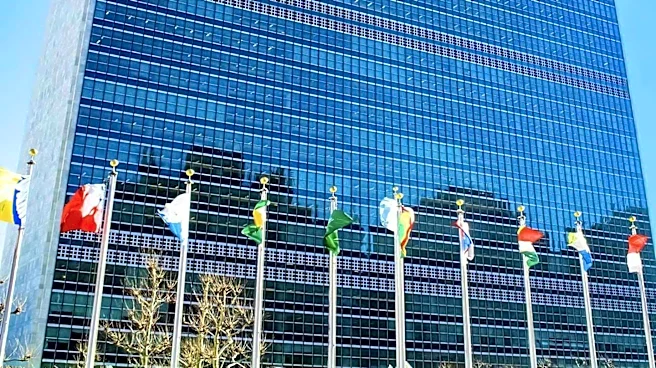
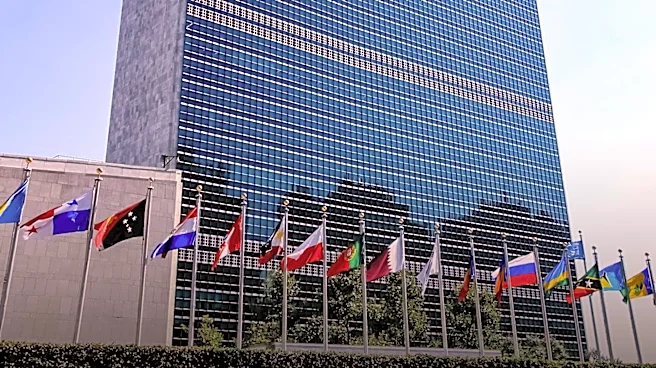
Taliban Foreign Minister Amir Khan Muttaqi has requested Kyrgyzstan's support for Taliban positions at the United Nations Security Council. This request was made during a phone call with Kyrgyz Foreign Minister Jeenbek Kulubaev. Kyrgyzstan was elected
in June as a non-permanent member of the Security Council for the 2027-2028 term. Muttaqi described Kyrgyzstan's election as a 'significant achievement' and emphasized the importance of 'mutual cooperation and support' between Afghanistan and Kyrgyzstan within the Security Council framework. The two ministers also discussed high-level exchanges, political consultations, and efforts to strengthen bilateral relations, including expanding political ties and economic cooperation through trade, investment, and joint projects. Kyrgyzstan does not formally recognize the Taliban administration but removed the Taliban from its list of terrorist organizations in 2024 and maintains political and economic contacts.
Why It's Important?
This development highlights the Taliban's ongoing efforts to gain international legitimacy and influence, particularly within a crucial global body like the UN Security Council. While Kyrgyzstan does not formally recognize the Taliban, its willingness to engage in diplomatic and economic discussions, and its removal of the Taliban from its terrorist list, signals a potential shift in how some nations are approaching the group. For the U.S. and its allies, this could complicate efforts to isolate the Taliban and pressure them on human rights issues, especially regarding women and girls. The Taliban's treatment of women and girls, including restrictions on education, employment, and public life, remains a major obstacle to wider international acceptance. Any support for the Taliban's positions in the UN could undermine the international community's unified stance on these critical human rights concerns.
What's Next?
Kyrgyzstan will assume its non-permanent seat on the UN Security Council in 2027, at which point the extent of its support for Taliban positions will become clearer. The Taliban will likely continue its diplomatic outreach to other nations, seeking to normalize its administration and gain formal recognition. The international community, including the U.S., will face ongoing challenges in balancing engagement with the Taliban to address humanitarian crises in Afghanistan against the imperative to uphold human rights and international norms. The UN's stance on Afghanistan's seat, currently held by a diplomat from the previous government, will remain a point of contention, as the Taliban has repeatedly sought to gain control of it. Future discussions will likely revolve around the conditions for recognition, including human rights, counterterrorism commitments, and the formation of a more inclusive government.
Beyond the Headlines
The Taliban's pursuit of UN Security Council support underscores a broader geopolitical strategy to break out of international isolation. By engaging with countries like Kyrgyzstan, the Taliban aims to gradually erode the international consensus against its regime, particularly concerning its human rights record. This strategy could lead to a fragmented international response to Afghanistan, where some nations prioritize pragmatic engagement over human rights concerns. The long-term implications could include a weakening of international norms regarding human rights, especially women's rights, if the Taliban gains more legitimacy without significant changes to its policies. This situation also highlights the complex interplay between national interests, regional stability, and global human rights advocacy in the context of non-state actors seeking state-like recognition.