








What's Happening?
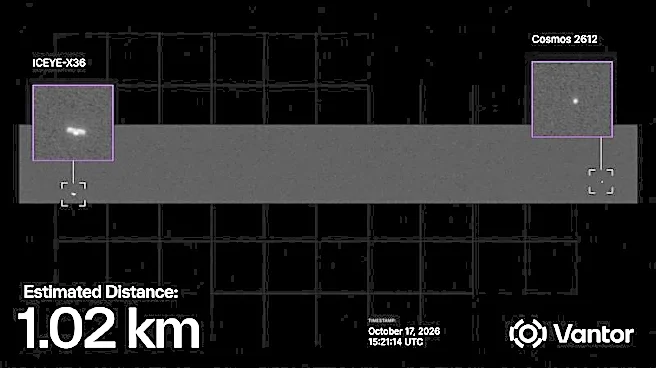
The U.S. military has been closely observing the maneuvers of a Russian satellite, Cosmos 2612, which recently approached a commercial synthetic aperture radar (SAR) satellite operated by ICEYE. According to Gen. Douglas Schiess, Chief of Space Operations
for the Space Force, this incident has heightened concerns regarding Moscow's space-based weapons and their potential threat to both military and commercial satellites. ICEYE's technology has been utilized to support Ukraine, which is currently in conflict with Russia. General Schiess emphasized the U.S. Space Force's expertise in space domain awareness and its ability to track such situations. He indicated that the incident serves as an example of other nations using space to signal their capabilities, underscoring the need for the Space Force to defend U.S. assets and learn from these events.
Why It's Important?
This incident highlights the escalating competition and potential for conflict in space, directly impacting U.S. national security and commercial interests. The close maneuvering of a Russian satellite near a commercial asset, particularly one supporting a U.S. ally, demonstrates the 'gray zone' activities that can challenge international norms without direct military engagement. For the U.S., it reinforces the critical need for robust space domain awareness and defensive capabilities to protect its extensive network of military and commercial satellites, which are vital for communication, navigation, intelligence, and reconnaissance. The Space Force's emphasis on defending U.S. assets and learning from these maneuvers indicates a proactive approach to deterring potential adversaries and ensuring the resilience of space-based infrastructure. This situation also underscores the growing role of commercial space companies in national security, making their assets potential targets in future conflicts.
What's Next?
The U.S. intelligence community and Space Force personnel are actively analyzing the lessons learned from the Cosmos 2612 incident. This analysis will likely inform future strategies for space domain awareness, defensive counterspace operations, and international engagement regarding responsible behavior in space. General Schiess's remarks suggest a continued focus on developing and potentially deploying on-orbit weapons for defensive purposes, a capability that Air Force Secretary Troy Meink previously revealed. While specific details about these weapons remain classified, their existence is intended as a deterrent. The Space Force will continue to evaluate its force design and budget allocations to ensure it possesses the necessary offensive and defensive capabilities to protect its interests and those of its allies in the evolving space environment.
Beyond the Headlines
The Russian satellite's maneuvers near a commercial SAR satellite raise significant questions about the definition of hostile acts in space and the appropriate international response. The Center for Strategic and International Studies suggests that such actions should be viewed within the broader context of aggressive Russian 'gray zone' activities. This incident could accelerate discussions within the U.S. and among its allies about establishing clearer rules of engagement and deterrence strategies for space. The increasing reliance on commercial satellites for critical national security functions also blurs the lines between military and civilian assets, potentially expanding the scope of future space conflicts. The Space Force's public acknowledgment of on-orbit weapons, even without specifics, signals a shift towards a more assertive posture in space, moving beyond purely defensive or surveillance roles to actively deterring and, if necessary, responding to threats.