






What's Happening?
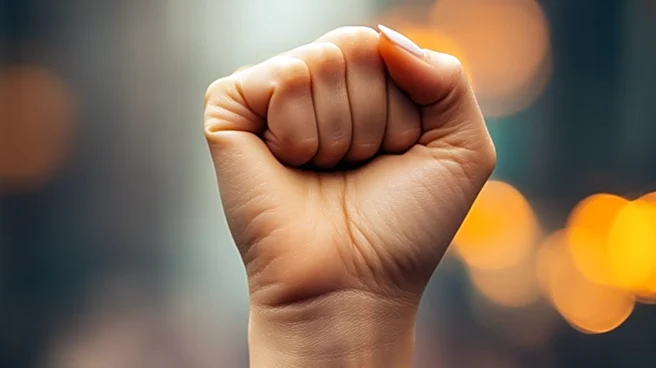
Fictional symbols from popular culture, such as the three-finger salute from 'The Hunger Games' and the Jolly Roger from 'One Piece,' are increasingly being adopted as protest icons in real-world demonstrations globally. The three-finger salute, originating
from Suzanne Collins’ 'The Hunger Games' where it signifies respect, mourning, and later resistance against an authoritarian regime, has been notably used in Thailand's pro-democracy protests and in Myanmar following the 2021 military coup. In Myanmar, protesters utilized this gesture to express solidarity with the movement against military rule. Similarly, the Jolly Roger of the Straw Hat Pirates from the Japanese manga and anime series 'One Piece,' which features a skull wearing a straw hat and symbolizes defiance against oppressive forces, has appeared in protests in Indonesia, Nepal, and the Philippines. These symbols are adapted by young activists to represent resistance to established power structures and demands for freedom and accountability, with their specific meanings evolving based on the local political context and grievances.
Why It's Important?
The adoption of fictional symbols in real-world protests highlights a significant shift in how social and political movements communicate and mobilize, particularly among younger generations. These symbols offer a universally recognizable language that transcends national and cultural boundaries, enabling broader solidarity and easier dissemination through digital platforms. For instance, the simplicity of the three-finger salute allows for instant reproduction by large crowds and rapid circulation online, amplifying its impact. This trend underscores the growing influence of global popular culture on political expression and activism. It also demonstrates how fictional narratives can provide powerful metaphors for real-life struggles against authoritarianism and corruption, fostering a sense of collective identity and purpose among diverse protest groups. The evolving meaning of these symbols, tailored to specific local grievances, reflects a dynamic and adaptable form of resistance that can challenge traditional forms of political discourse.
What's Next?
The continued use of fictional symbols in protests suggests a potential for these gestures to become more ingrained in global activism, influencing future movements and their visual communication strategies. As popular culture continues to expand its reach, more fictional elements may be co-opted to represent various causes, potentially leading to a richer and more diverse lexicon of protest symbols. This trend could also prompt authorities to adapt their responses, as these symbols often bypass traditional censorship mechanisms due to their non-explicit political origins. Furthermore, the success of these symbols in mobilizing and uniting protesters may encourage creators of fictional works to consider the potential real-world impact and interpretation of their creations. The ongoing adaptation of these symbols will likely continue to reflect the specific political and social grievances of different regions, making them a dynamic indicator of global unrest and calls for change.
Beyond the Headlines
The phenomenon of fictional symbols becoming protest icons delves into deeper implications concerning the intersection of popular culture, collective identity, and political resistance. It suggests that shared cultural narratives, even those originating in fiction, can serve as powerful tools for social cohesion and mobilization, particularly in an era of widespread digital media consumption. This trend raises questions about the nature of symbolism in modern activism, moving beyond traditional political emblems to embrace more accessible and emotionally resonant imagery. The ability of these symbols to convey complex messages of defiance and solidarity without explicit text or direct political affiliation can make them particularly effective in environments where overt political expression is suppressed. Moreover, it highlights the role of youth culture and globalized media in shaping contemporary political landscapes, demonstrating how seemingly innocuous cultural products can be reappropriated to challenge power structures and inspire collective action on a global scale.