






What's Happening?
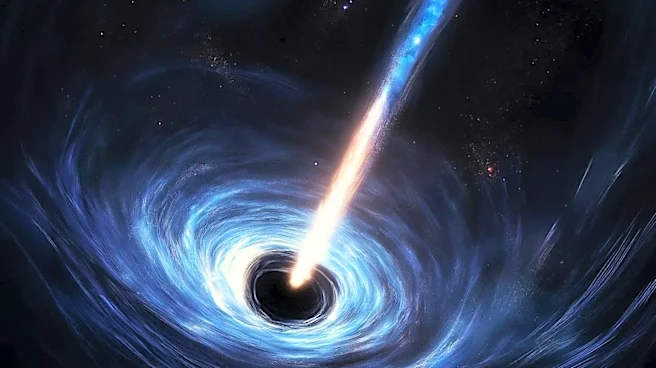
Astronomers, utilizing NASA's Swift X-ray spacecraft and radio observations, have documented a supermassive black hole consuming matter and subsequently emitting radio jets approximately 300 days later. This celestial event occurred at the center of galaxy
NGC 1275, situated about 225 light-years away within the Perseus Cluster. The supermassive black hole initially exhibited an X-ray flare in February 2023, which lasted less than 60 days and included two five-day bursts, doubling its X-ray brightness. This flaring indicated a significant increase in the rate at which the black hole was accreting matter. Researchers, led by Sarah Ketchum of the University of Michigan, ruled out a tidal disruption event (TDE) as the cause, concluding that the flaring was due to a spike in matter accretion. By analyzing Swift data, the team estimated the black hole's mass to be between 100 million and 1 billion times that of the sun. This observation is crucial for understanding the relationship between the accretion disk and the powerful jets launched by black holes.
Why It's Important?
This observation provides critical insights into the 'disk-jet coupling' phenomenon, which is fundamental to understanding how black holes influence star formation and the overall growth of galaxies. The ability to observe the delayed radio jet emission after an X-ray flare offers a unique opportunity to study the time it takes for plasma to travel from the base of the jet to a shock point in the surrounding gas or dust. This research contributes significantly to the field of astrophysics by refining models of active galactic nuclei (AGNs) and their impact on their host galaxies. The Perseus Cluster, with NGC 1275 at its center, serves as an ideal laboratory for these studies, allowing astronomers to better comprehend the energetic processes driven by supermassive black holes and their broader cosmological implications. The findings help to clarify the mechanisms by which black holes regulate the evolution of galactic structures.
What's Next?
Future research will focus on further testing the observed 300-day delay between X-ray flaring and radio wave emission. The current X-ray data for NGC 1275 is somewhat sparse, making it challenging to establish a precise relationship between the X-ray and radio radiation over extended periods. Therefore, more frequent and comprehensive X-ray observations are needed to solidify this connection. Researchers anticipate that if X-ray flares originate close to the black hole, an 'echo' of these flares should be detectable from the accretion disk, possibly in the form of an emission line from neutral iron. To confirm this, numerous observations with advanced instruments like XMM-Newton and the X-Ray Imaging and Spectroscopy Mission (XRISM) will be essential. These future observations will provide a more detailed understanding of the complex interplay between accretion and jet ejection in supermassive black holes.
Beyond the Headlines
The study of supermassive black holes and their influence on galaxy evolution extends beyond mere astronomical observation; it touches upon fundamental questions about the universe's structure and development. The 'disk-jet coupling' mechanism, as highlighted in this research, suggests a profound connection between the most extreme objects in the cosmos and the birth of stars, which are the building blocks of galaxies. This intricate relationship implies that black holes are not just passive gravitational sinks but active participants in shaping their cosmic environments. Understanding these processes could lead to a more complete picture of how galaxies form and evolve over billions of years, potentially revealing insights into the conditions necessary for life to emerge in the universe. The ongoing advancements in observational technology, despite their limitations, continue to push the boundaries of our cosmic understanding.