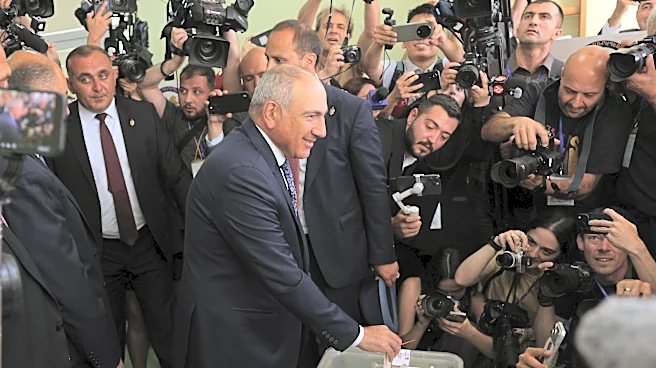









What's Happening?
Armenian Prime Minister Nikol Pashinyan has declared victory in the recent parliamentary elections, securing 49.81% of the vote according to Armenia’s Central Election Commission. This result places Pashinyan's Civil Contract party ahead of the opposition
Strong Armenia party. However, the outcome does not provide him with the overwhelming mandate needed to fully implement his agenda, which includes reducing Armenia's reliance on Russia and strengthening ties with the European Union. The election was seen as a referendum on Armenia's foreign policy direction, with Pashinyan advocating for peace with Azerbaijan and improved relations with Turkey. Despite the victory, Pashinyan faces challenges in pushing through constitutional changes demanded by Azerbaijan for a lasting peace deal.
Why It's Important?
Pashinyan's victory is significant as it represents a potential shift in Armenia's geopolitical alignment, moving away from Russia, its traditional ally, towards closer ties with the West. This shift could have broad implications for regional stability and Armenia's economic future. The Kremlin has expressed displeasure with Armenia's pivot, imposing import bans on Armenian products as a form of economic pressure. The election results could also impact Armenia's internal politics, as Pashinyan's ability to implement his foreign policy agenda may be constrained by the lack of a two-thirds majority in parliament. The outcome of these elections could influence Armenia's role in the South Caucasus and its relations with neighboring countries.
What's Next?
Pashinyan will need to navigate complex diplomatic and domestic challenges to advance his agenda. He may seek to negotiate with smaller parties to gain the necessary support for constitutional changes. The international community, particularly the European Union, may play a supportive role in Armenia's transition, as indicated by European Commission President Ursula von der Leyen's promise of an EU support package. However, Pashinyan must also manage relations with Russia, balancing Armenia's new foreign policy direction with the need to maintain some level of cooperation with Moscow. The opposition's claims of election irregularities could also lead to political tensions within Armenia.
Beyond the Headlines
The election results highlight the broader geopolitical tensions in the region, as Armenia's shift towards the West could alter the balance of power in the South Caucasus. This move may encourage other countries in the region to reconsider their alliances and foreign policy strategies. Additionally, the election underscores the challenges faced by countries attempting to transition from Russian influence to closer ties with Western institutions. The outcome of Armenia's foreign policy shift will depend on Pashinyan's ability to manage both domestic and international pressures while pursuing his reform agenda.