







What's Happening?
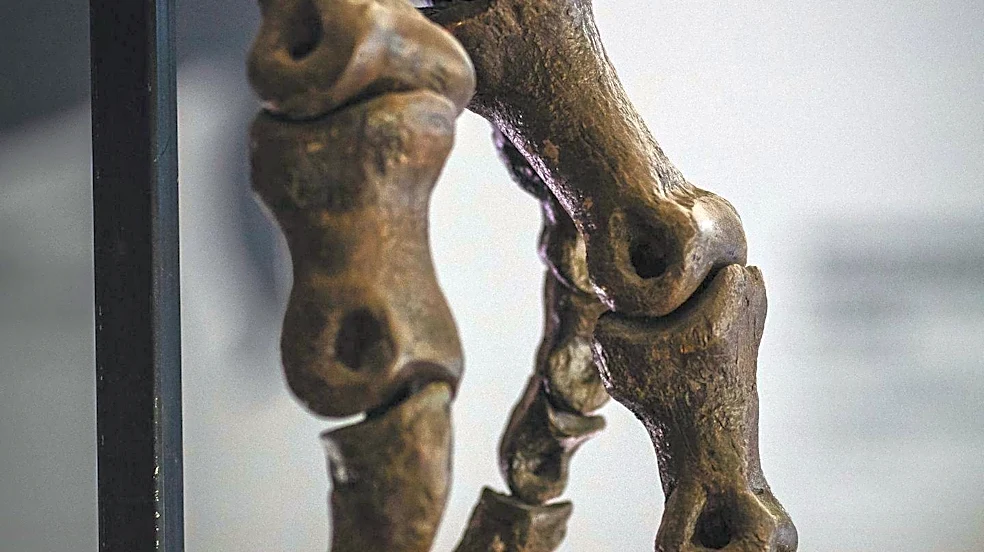
A dinosaur fossil, previously overlooked for nearly a century in the Natural History Museum in London, has been identified as a new species of megaraptoran, named Invictibellatrix amberina. This discovery marks the first confirmed evidence of a megaraptoran dinosaur in Europe.
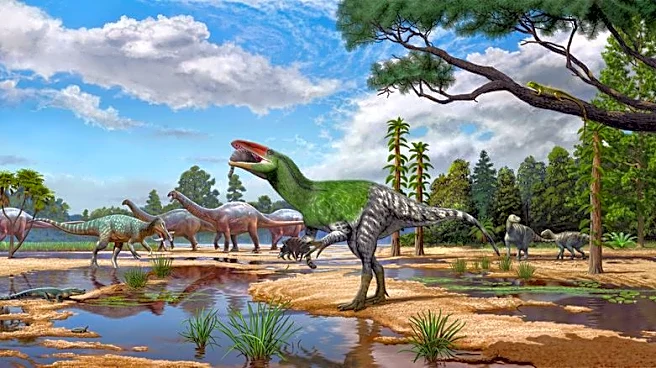
Megaraptorans are a group of agile, two-legged carnivores closely related to tyrannosaurs, but they primarily attacked prey using their large arms and giant curved claws rather than their jaws. The Invictibellatrix amberina lived approximately 120 million years ago during the Early Cretaceous period. Researchers utilized CT scanning technology to examine the fossil, a skull fragment, creating a 3D model to analyze its internal structure. This analysis revealed a unique combination of skull features, including an oval hole where the spinal cord entered the brain and an hourglass-shaped crest, which led to its classification as a new species. The dinosaur is estimated to have been between 3 to 4 meters long and about 1.5 meters tall, with potential feathers and claws measuring 10cm to 20cm. It would have preyed on small dinosaurs, lizards, and mammals, occupying an ecological role similar to a hyena today.
Why It's Important?
The identification of Invictibellatrix amberina is significant for understanding the global distribution and evolution of megaraptorans. Previously, these dinosaurs were primarily found in Asia, Australia, and South America, making this European discovery a crucial piece of the paleontological puzzle. It provides direct evidence supporting the theory that megaraptorans were present in Europe and migrated to Gondwana via this route, rather than through island-hopping further south. This finding challenges previous assumptions about their geographical spread and highlights the importance of re-examining historical museum collections, as many discoveries may still be hidden within them. The study also sheds light on the diversity of carnivorous dinosaurs in the Early Cretaceous period in Europe, a region where such finds have been particularly rare. Understanding the migratory patterns and ecological roles of these ancient predators contributes to a more complete picture of prehistoric ecosystems and the factors that influenced dinosaur evolution and extinction.
What's Next?
The discovery of Invictibellatrix amberina is expected to spur further research into historical museum collections, particularly those from the Isle of Wight, which continues to yield new dinosaur species. Paleontologists will likely focus on re-evaluating other unidentified or misclassified fossils using advanced imaging techniques like CT scanning, which proved instrumental in this discovery. This could lead to the identification of more new species and a deeper understanding of dinosaur diversity. Future studies may also delve into the environmental and climatic conditions of the Early Cretaceous period in Europe to better understand why megaraptorans, despite being globally widespread then, later became extinct in the northern landmass of Laurasia. Researchers might also investigate the competitive dynamics between megaraptorans and other tyrannosaurs to determine if competing predators played a role in their regional disappearance. The ongoing analysis of megaraptoran fossils will continue to refine our understanding of their evolutionary trees and their role as apex predators in different parts of the world.
Beyond the Headlines
This discovery underscores the enduring value of historical scientific collections and the potential for new insights to emerge from existing data through the application of modern technology. The fact that a significant fossil remained unstudied for nearly a century highlights the vast amount of untapped information within museum archives globally. It also brings to light the often-underestimated contributions of amateur paleontologists, as Reginald Walter Tooley, who originally found the fossil, played a crucial role in its preservation. Ethically, this emphasizes the responsibility of institutions to continually re-evaluate and make accessible their collections for scientific scrutiny. Culturally, the identification of a new dinosaur species, particularly a carnivorous one, continues to captivate public imagination and reinforces the dynamic nature of scientific discovery. It serves as a reminder that our understanding of Earth's ancient past is constantly evolving, with new revelations often coming from unexpected places, even from within long-held museum drawers.