
What's Happening?
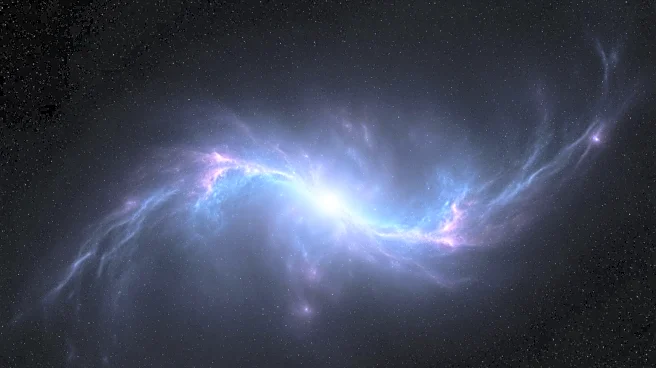
During a press conference at the American Astronomical Society meeting in Phoenix, Rachael Beaton, a member of the COPAG Executive Committee, announced the discovery of a starless galaxy named Cloud-9.
This galaxy was initially identified using radio telescopes, and subsequent observations with the Hubble Space Telescope confirmed the absence of stars, despite the presence of radio-emitting gas. The discovery of Cloud-9, which is believed to be primarily composed of dark matter, was unexpected and has been published in the Astrophysical Journal Letters. The finding suggests the existence of galaxies that do not contain stars, a concept that has been theorized but not previously observed.
Why It's Important?
The discovery of a starless galaxy like Cloud-9 is significant as it challenges existing astronomical theories and enhances our understanding of galaxy formation and composition. This finding could lead to new insights into the role of dark matter in the universe, as these types of galaxies are thought to be predominantly composed of it. The implications for astrophysics are profound, as it may prompt a reevaluation of how galaxies are classified and studied. This discovery also highlights the capabilities of the Hubble Space Telescope in advancing our knowledge of the cosmos, potentially influencing future research directions and funding priorities in space exploration and astronomy.