
What's Happening?
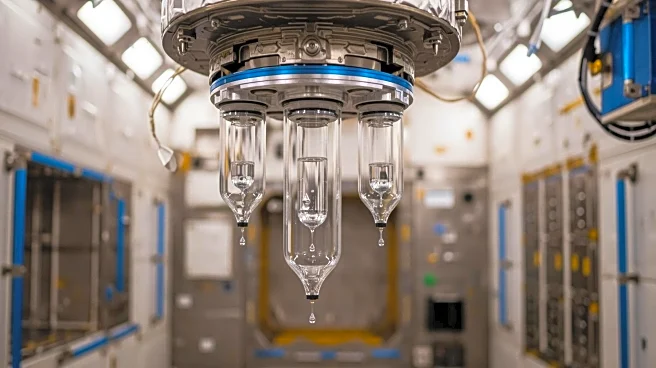
NASA is conducting the Fluid Particles experiment aboard the International Space Station's Destiny laboratory module. This experiment involves observing how particles cluster and form larger structures
in microgravity, using a bulk container filled with viscous fluid and embedded particles subjected to oscillating frequencies. The research aims to advance fire suppression, lunar dust mitigation, and plant growth in space. Additionally, the findings could inform understanding of pollen dispersion, algae blooms, plastic pollution, and sea salt transport during storms on Earth. This research is part of NASA's broader efforts to support long-duration missions like Artemis and future human expeditions to Mars.
Why It's Important?
The microgravity research conducted by NASA has significant implications for both space exploration and Earth-based applications. By understanding particle behavior in microgravity, NASA can develop technologies that enhance safety and efficiency in space missions, such as improved fire suppression systems and strategies for managing lunar dust. On Earth, insights from this research can contribute to environmental management, including better understanding of pollution and natural phenomena. The experiment also supports NASA's Artemis program, which aims to return humans to the Moon and eventually send astronauts to Mars, by providing critical data for long-duration space missions.