
What's Happening?
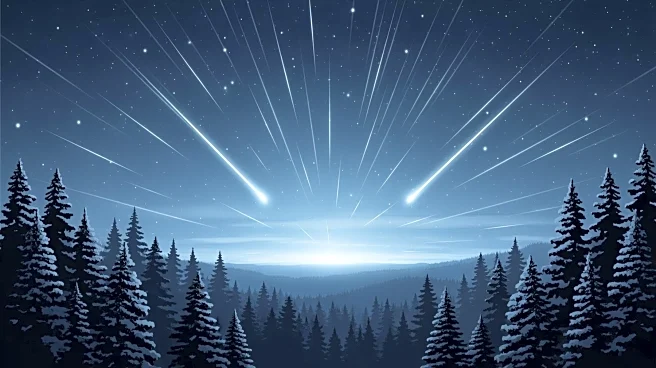
The Ursid meteor shower is set to peak on December 22, offering a celestial display of approximately 10 meteors per hour under dark, moonless skies. This event coincides with the winter solstice on December 21,
marking the shortest day of the year in the Northern Hemisphere. The Ursids, originating from the constellation Ursa Minor, are visible throughout the night, providing a spectacle for stargazers. Additionally, the week features other astronomical phenomena, including the transit of Jupiter's moon Io and the visibility of Comet 24P/Schaumasse in the Virgo Cluster. The winter solstice signifies the start of astronomical winter, with the Northern Hemisphere experiencing its shortest daylight duration.
Why It's Important?
The Ursid meteor shower and the winter solstice are significant for both amateur and professional astronomers, offering opportunities for observation and study. The solstice marks a pivotal point in the Earth's orbit, influencing climate patterns and cultural traditions. The meteor shower provides a chance to engage the public in astronomy, fostering interest in science and the natural world. These events also highlight the interconnectedness of celestial phenomena and their impact on Earth, serving as a reminder of the broader universe beyond our planet.
What's Next?
Following the peak of the Ursid meteor shower, astronomers and enthusiasts will continue to monitor other celestial events, such as the movements of Comet 24P/Schaumasse and the transit of Jupiter's moons. The gradual lengthening of daylight hours post-solstice will be observed, affecting various ecological and human activities. Future astronomical events will continue to draw interest, with the potential for new discoveries and insights into the workings of our solar system and beyond.
Beyond the Headlines
The winter solstice and meteor showers like the Ursids have cultural and historical significance, often associated with myths and traditions across different societies. These events can inspire reflection on humanity's place in the universe and the passage of time. The study of such phenomena contributes to our understanding of celestial mechanics and the history of the solar system, offering insights into the formation and evolution of planetary bodies.