
What's Happening?
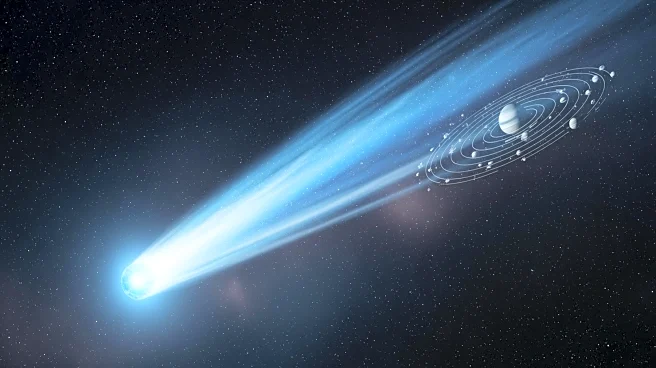
The interstellar comet 3I/ATLAS, which recently made its closest approach to Earth on December 19, 2025, is now on its way out of the solar system. Discovered by the NASA-funded ATLAS survey telescope
in Chile, this comet is only the third known object to originate from outside our solar system, following 1I/‘Oumuamua and 2I/Borisov. As it moves away, scientists are utilizing various telescopes and instruments to gather data, including X-ray observations from XRISM and XMM-Newton, and radio observations that have detected natural cometary emissions. The comet's trajectory and characteristics are being closely monitored, with NASA confirming that it poses no threat to Earth.
Why It's Important?
The study of 3I/ATLAS provides a unique opportunity for scientists to understand more about interstellar objects and their compositions. The comet's passage allows for a coordinated global effort to observe and analyze its properties across different wavelengths, offering insights into the materials and processes that occur in other star systems. This research could enhance our understanding of the building blocks of planets and the potential for life elsewhere in the universe. Additionally, the comet serves as a test case for improving global tracking methods, which are crucial for monitoring potentially hazardous objects in the future.
What's Next?
As 3I/ATLAS continues its journey out of the solar system, it is expected to pass closer to Jupiter in March 2026. Observations will continue until spring 2026, providing further data for analysis. The comet's departure marks the end of a significant observational campaign, but the data collected will be analyzed for years to come, contributing to our understanding of interstellar phenomena. The International Asteroid Warning Network is using this opportunity to refine its tracking and reporting techniques, which could improve our preparedness for future interstellar visitors.