


What's Happening?
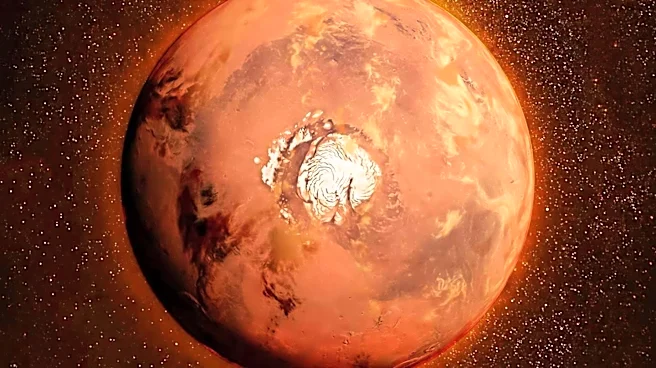
Researchers have identified a new mechanism, homogeneous nucleation, to explain the formation of the Arsia Mons Elongated Cloud (AMEC) on Mars. This cloud, observed daily over the Arsia Mons volcano during the Martian spring and summer, stretches up to 1,100
miles (1,800 km) and moves westward at approximately 380 mph (610 km/h). Previous computer models based on conventional cloud formation, known as heterogeneous nucleation (where water vapor condenses around dust particles), failed to replicate the cloud's distinctive tail. The new study, published in Nature Geoscience, suggests that ice crystals form directly from water vapor in an exceptionally clean and cold atmospheric pocket above Arsia Mons. This process, never before observed in a planetary atmosphere, occurs due to the volcano's immense size, Mars' thin atmosphere, and the scarcity of dust at high altitudes, creating conditions for supersaturation where water vapor freezes independently.
Why It's Important?
This discovery significantly advances our understanding of atmospheric processes on Mars and potentially other celestial bodies. The identification of homogeneous nucleation as a viable cloud formation mechanism challenges previous assumptions and expands the scientific community's knowledge of planetary meteorology. It highlights the unique atmospheric conditions that can exist on other planets, where extreme cold and lack of particulates allow for processes not commonly seen on Earth. This new insight could lead to more accurate climate models for Mars, improving predictions for future missions and enhancing our ability to interpret data from other planets. Furthermore, it opens avenues for re-evaluating cloud formation theories in Earth's upper atmosphere and Venus, where similar conditions might theoretically exist, thus broadening the scope of atmospheric science.
What's Next?
The research team plans to investigate whether the Arsia Mons Elongated Cloud is a unique phenomenon or if homogeneous nucleation plays a role in shaping other clouds or the water cycle across Mars. Future studies will likely involve further refinement of atmospheric models to incorporate this newly identified mechanism and explore its implications for Martian climate dynamics. Scientists will also be looking for evidence of similar processes on other planets with thin atmospheres or extreme conditions. This could involve analyzing existing data from other planetary missions or designing new observational strategies to detect such cloud formations. The findings may also prompt a re-examination of historical atmospheric data from Mars and other planets to identify previously unexplained cloud phenomena that could be attributed to homogeneous nucleation.
Beyond the Headlines
The revelation of homogeneous nucleation on Mars has profound implications beyond just cloud formation. It suggests that planetary atmospheres can harbor complex and unexpected physical processes, pushing the boundaries of our current atmospheric science paradigms. This discovery underscores the importance of continued exploration and observation of other planets, as they can provide natural laboratories for phenomena not readily observable or reproducible on Earth. The concept of 'exotic physics' being active in nature, as described by lead author Jorge Hernández-Bernal, challenges the notion that textbook theories are purely theoretical, demonstrating that extreme conditions can bring them to life. This could inspire new theoretical work and experimental designs to explore the conditions under which such processes might occur in other environments, potentially even in industrial or laboratory settings.