



What's Happening?
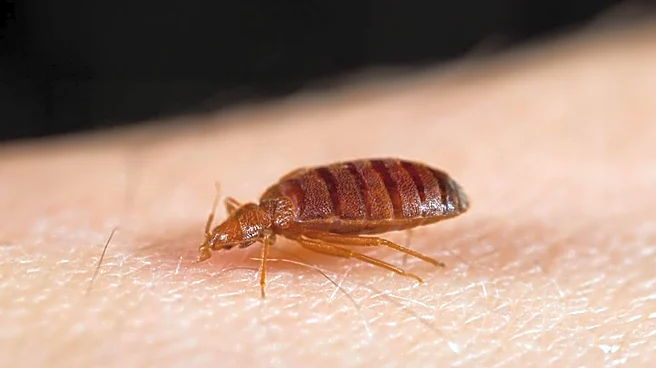
Christopher Hayes, an assistant professor at North Carolina State University, has been actively involved in bedbug research, enduring over 50 bites as part of his studies. His work highlights the increasing prevalence of bedbug infestations, which are
particularly problematic during certain times of the year. Hayes notes that these pests, often referred to as 'vampires of the insect world,' hide during the day and feed on human blood at night. While traditionally not considered disease vectors, recent experiments, including one by University of South Dakota researchers, suggest bedbugs might be capable of acquiring and transmitting antibiotic-resistant infections like MRSA. This raises new public health concerns regarding these resilient insects. Bedbugs are also becoming more resistant to pesticides, including DDT, which was widely used post-WWII before its ban in 1972. This resistance contributes to their resurgence and makes eradication more challenging.
Why It's Important?
The research conducted by Professor Hayes and others is crucial for public health in the U.S. The increasing resistance of bedbugs to common pesticides means that traditional eradication methods are becoming less effective, leading to more widespread and persistent infestations. The potential link between bedbugs and the transmission of MRSA, an antibiotic-resistant infection, could significantly elevate the public health threat posed by these pests. If confirmed, this would transform bedbugs from a nuisance into a direct health hazard, potentially increasing healthcare costs and the burden on medical facilities. Furthermore, infestations disproportionately affect low-income and public housing communities, which may lack the resources for professional extermination, exacerbating health disparities. Understanding bedbug behavior and developing new control strategies is vital to protect communities and prevent the spread of potential diseases.
What's Next?
Further research is needed to definitively confirm whether bedbugs actively spread MRSA to humans in real-world scenarios, as indicated by the University of South Dakota experiment. This will likely involve follow-up studies to validate the findings and understand the mechanisms of transmission. Public health organizations and pest control industries will need to adapt their strategies to combat pesticide-resistant bedbug populations, potentially exploring new chemical treatments or non-chemical methods like heat treatments and silica dust. Educational campaigns may also be necessary to inform the public about prevention measures, such as inspecting luggage and secondhand furniture, and the importance of early intervention. The scientific community will continue to monitor bedbug populations and their potential role in disease transmission to develop more effective control and prevention protocols.
Beyond the Headlines
The resurgence of bedbugs and the emerging concerns about their role in disease transmission highlight broader issues in public health and environmental policy. The historical use and subsequent ban of DDT illustrate the complex interplay between pest control, environmental impact, and the evolution of pest resistance. The current situation underscores the need for continuous research into pest biology and integrated pest management strategies that are both effective and environmentally sound. The potential for bedbugs to transmit MRSA also raises ethical considerations regarding public health responsibilities, particularly for vulnerable populations in densely populated areas or communal living spaces. This development could prompt a re-evaluation of how public health agencies categorize and respond to pest infestations, potentially leading to increased funding for research and more robust public health interventions.