



What's Happening?
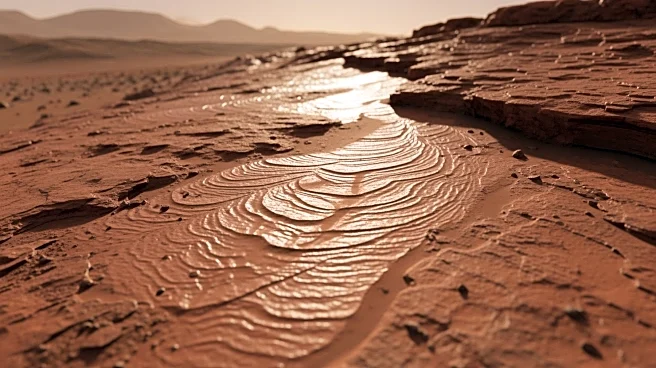
NASA's Perseverance Rover has discovered fragments of bleached clay on Mars, suggesting the planet once experienced tropical rainfall. Researchers from Purdue University analyzed these fragments, which indicate Mars was warm and wet for millions of years,
similar to Earth's tropical regions. The findings, based on the rover's exploration of the Jezero Crater, provide further evidence that Mars had conditions suitable for life. The presence of kaolinite, a clay mineral formed under tropical conditions, supports the theory of a once-habitable Martian environment.
Why It's Important?
This discovery adds to the growing body of evidence that Mars was once a habitable planet, potentially supporting life. Understanding Mars' climatic history is crucial for future exploration and the search for past life. The findings could inform the selection of landing sites for future missions and guide the search for biosignatures. Additionally, this research enhances our understanding of planetary evolution and the factors that contribute to habitability, offering insights that could be applied to the study of exoplanets.