






What's Happening?
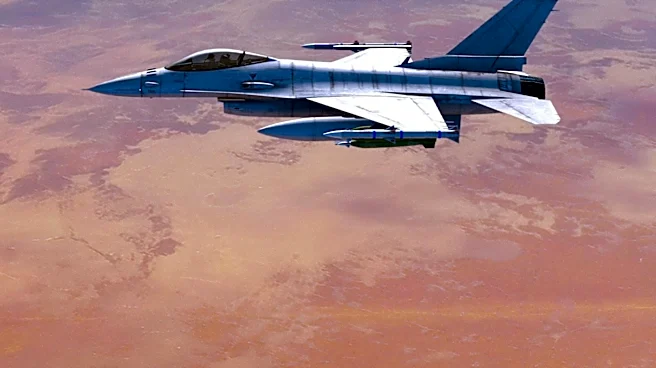
The U.S. Air Force has awarded Northrop Grumman a $79,608,480 contract modification to continue upgrading F-16C/D fighter jets with Active Electronically Scanned Array (AESA) radar. This contract, managed by the Air Force Life Cycle Management Center
at Wright-Patterson Air Force Base, was signed on October 22 and publicly announced on November 13. The funding will support the installation of the AN/APG-83 Scalable Agile Beam Radar (SABR), replacing the older mechanically scanned AN/APG-68 systems. The work will be conducted at Northrop Grumman’s facility in Linthicum Heights, Maryland, and is scheduled to run through December 31, 2027. This modification increases the contract's cumulative value to approximately $2.06 billion, with $65.4 million allocated for procurement and $14.2 million for research, development, test, and evaluation, all obligated at the time of the award for fiscal years 2025 through 2027.
Why It's Important?
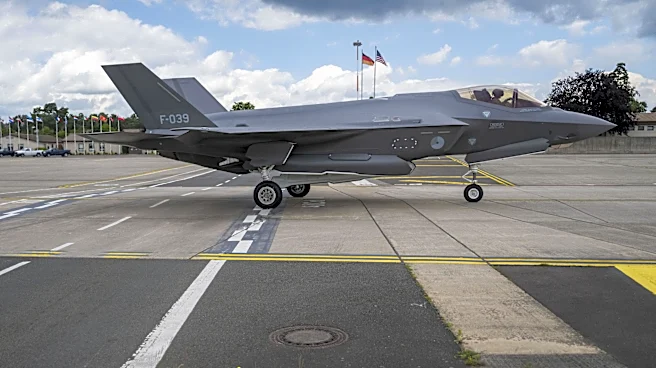
This contract is crucial for maintaining the operational viability of the U.S. Air Force's F-16 fleet, which remains its largest fighter fleet by aircraft count. The upgrade to AESA radar significantly enhances the F-16's capabilities, allowing pilots to track multiple targets simultaneously, reducing the aircraft’s detectability in contested electronic environments, and sharing sub-components with the F-35's AN/APG-81 radar. This modernization effort is designed to keep 450 active-duty and Air National Guard F-16s viable well into the 2030s, bridging the gap as F-35 deliveries continue. The APG-83's ability to fit into the F-16's existing nose space without major structural overhauls makes it a cost-effective upgrade. Beyond the U.S., this program serves as a reference point for over 25 countries operating F-16s, many of whom are considering or implementing similar radar upgrades, impacting export licensing and unit costs for allied nations purchasing new F-16V jets.
What's Next?
The Air Force Life Cycle Management Center has indicated that similar radar modernization awards will continue in coming fiscal years. The priority will be to complete the current scope of upgrading 450 F-16 aircraft rather than expanding the quantity further. Northrop Grumman will proceed with the installation of the AN/APG-83 SABR units, with work continuing through December 2027. The ongoing success and efficiency of this program will likely influence future defense spending and modernization strategies for other legacy aircraft. International F-16 operators will continue to monitor the U.S. program's progress, using it as a benchmark for their own fleet upgrades and procurement decisions, particularly concerning the F-16V variant.
Beyond the Headlines
The continuous investment in upgrading the F-16 fleet, even with the ongoing F-35 deliveries, highlights a strategic approach to defense modernization that balances cutting-edge technology with cost-effective enhancements of existing assets. This dual-track strategy ensures that the U.S. Air Force maintains a robust and capable fighter force across various operational needs and budget constraints. The AESA radar upgrade not only improves the F-16's combat effectiveness but also extends its operational lifespan, providing a more sustainable and adaptable air defense posture. Furthermore, the commonality of some sub-components between the F-16's APG-83 and the F-35's APG-81 radars suggests a broader strategy of interoperability and logistical efficiency across different fighter platforms. This approach could influence future defense procurement, emphasizing modularity and shared technologies to optimize maintenance, training, and overall operational costs for the U.S. and its allies.