








What's Happening?
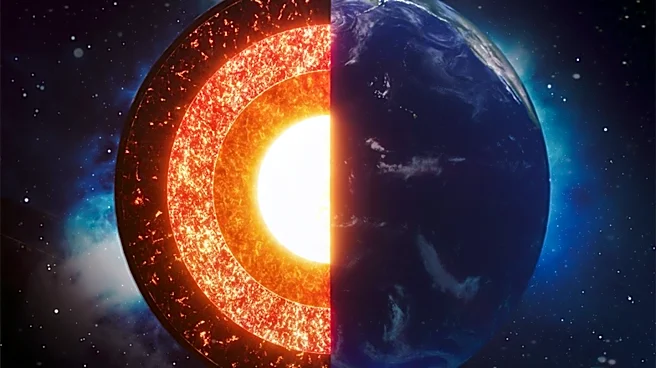
A recent study published in the Journal of Studies of Earth’s Deep Interior has revealed a surprising reversal in the flow of molten iron beneath the Pacific Ocean. This discovery challenges the long-standing belief that the Earth's outer core changes
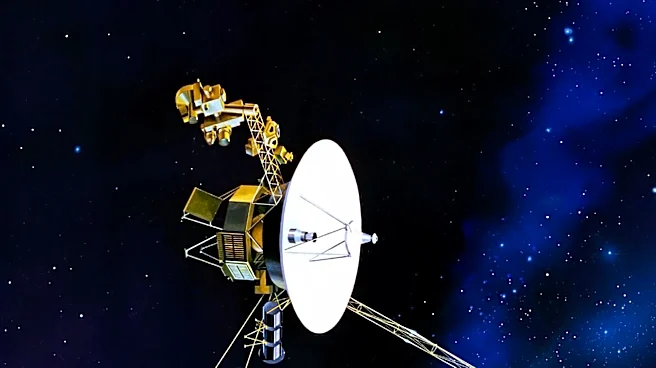
only gradually over decades. The study, which combines nearly 30 years of ground-based and satellite observations, found that a vast region of liquid iron abruptly changed direction, moving from a weak westward flow to a strong eastward flow around 2010. This unexpected shift provides new insights into the dynamic processes that drive Earth's magnetic field, which is generated by the motion of molten iron in the outer core. The research utilized data from ESA’s Swarm and CryoSat missions, as well as the German CHAMP and Danish Ørsted satellites, to examine the event in unprecedented detail.
Why It's Important?
The findings of this study have significant implications for our understanding of Earth's magnetic field, which plays a crucial role in protecting the planet from harmful solar radiation. The magnetic field is essential for navigation systems, spacecraft operations, and models of near-Earth space weather. The discovery of the reversal in core flow suggests that the outer core is more dynamic than previously thought, with potential connections to changes occurring even deeper within the Earth. This challenges the idea that the outer core is mainly controlled by stable westward circulation and highlights the need for continued monitoring to understand the long-term behavior of Earth's deep interior. The study's insights could lead to improved models of Earth's magnetic field evolution, which are vital for both scientific research and practical applications.
What's Next?
Researchers are now focused on determining whether the observed reversal represents a short-lived fluctuation, part of a repeating oscillation, or a new stable equilibrium for core circulation. Continued satellite observations will be crucial in tracking how the flow evolves over the coming years. Future missions like ESA's Swarm will play a key role in providing continuous global coverage, allowing scientists to monitor changes in the geodynamo in near-real time. This ongoing research may also help scientists investigate possible interactions between Earth's outer core, inner core, and lower mantle, offering more insights into the core-mantle boundary, a critical region for deep Earth dynamics.
Beyond the Headlines
The study raises intriguing questions about the dynamic connections between Earth's deepest layers. As the magnetic field continues to evolve, satellite missions are providing an increasingly detailed view of the processes unfolding deep inside our planet. This research suggests that Earth's core may be far more variable and complex than once believed, with regional changes emerging rapidly within just a decade. Understanding these processes is essential for both basic science and practical applications, as they have direct implications for navigation, communication, and space weather forecasting.