
What's Happening?
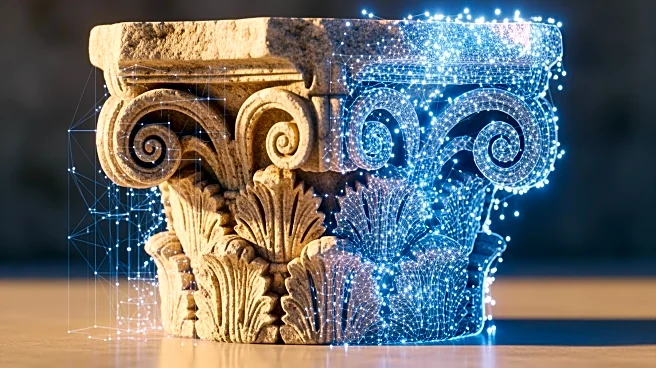
A recent study has applied Generative Adversarial Networks (GANs) to improve the restoration of ancient architectural heritage images, specifically focusing on beacon ruins in Xinjiang. The research utilized two models, CycleGAN and Pix2Pix, to address
the challenges posed by small sample sizes and the need for high-quality image restoration. The CycleGAN model, which operates on unsupervised learning, was used to generate paired data for the Pix2Pix model, which relies on supervised learning. This approach allowed for the creation of high-quality matching samples necessary for effective restoration. The study found that the Pix2Pix model, when optimized, showed significant improvements in image quality, achieving a peak signal-to-noise ratio (PSNR) of 29.43 dB and a structural similarity index (SSIM) of 0.73, outperforming the CycleGAN model. The research highlights the potential of GANs in enhancing the fidelity and structural consistency of restored images, which is crucial for the preservation of cultural heritage.
Why It's Important?
The application of GANs in the restoration of ancient architectural images is significant as it offers a technological advancement in preserving cultural heritage. By improving the quality and accuracy of restored images, this method provides a more reliable reference for conservation efforts. The enhanced image fidelity and structural consistency achieved through the Pix2Pix model can aid in the accurate reconstruction of historical sites, which is vital for educational and cultural preservation purposes. This approach not only addresses the limitations of traditional restoration methods but also sets a precedent for future applications of AI in heritage conservation. The study's success in using GANs to overcome data scarcity and improve restoration quality could lead to broader adoption of AI technologies in similar fields, potentially transforming how cultural heritage is preserved and studied.
What's Next?
The study suggests that further optimization and application of the Pix2Pix model could lead to even greater improvements in restoration quality. Future research may focus on expanding the diversity of training data and enhancing the model's generalization capabilities to handle more complex and varied restoration tasks. Additionally, the integration of AI-generated data with traditional restoration methods could be explored to create a more comprehensive approach to heritage conservation. As the technology continues to evolve, it is likely that GANs will play an increasingly important role in the digital preservation of cultural heritage, offering new tools and methodologies for conservators and researchers.
Beyond the Headlines
The use of GANs in heritage restoration raises important ethical and cultural considerations. While AI can significantly enhance restoration efforts, it is crucial to ensure that the technology is used responsibly and that the restored images remain true to historical accuracy. The reliance on AI-generated data must be balanced with expert knowledge and traditional methods to maintain the integrity of cultural heritage. Furthermore, as AI technologies become more prevalent in this field, there may be a need for new guidelines and standards to govern their use, ensuring that they complement rather than replace human expertise.