



What's Happening?
Gary Siders Sr., a 73-year-old man from rural southern Ohio, has been found mentally incompetent to stand trial. This ruling comes after his 16 grandchildren were discovered living in squalid conditions in his Hamden home. A judge in Vinton County accepted
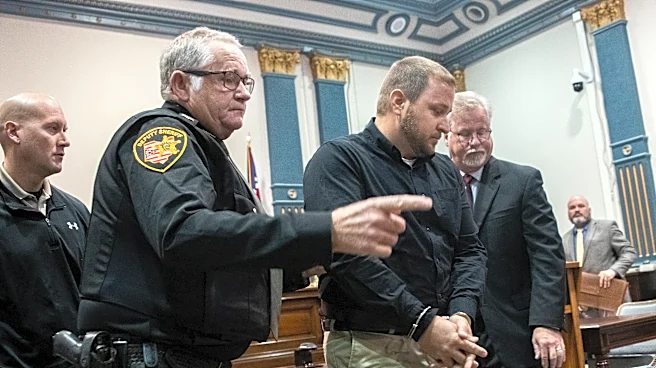
the findings of an evaluation report, a decision that Vinton County Prosecutor William Archer did not object to. Siders Sr. appeared in court in a wheelchair, and his attorney, Dorian Baum, stated that his mental health has been declining for years and is considered 'not restorable.' Baum further noted that Siders Sr. 'doesn’t fully understand or appreciate what’s going on.' Siders Sr. was charged with 16 counts of child endangerment following the rescue of the children on June 30. The children, ranging from 18 months to 18 years old, were reportedly confined to a small room under deplorable conditions, with some described as 'feral' and unable to speak. Authorities also noted varying medical conditions among the children. Other family members, including Siders Sr.'s wife, Christina Siders; son Gary Siders Jr.; and daughter-in-law, Elizabeth Siders, have pleaded not guilty to related charges.
Why It's Important?
This ruling highlights significant issues within the U.S. legal system regarding mental competency and the prosecution of elderly individuals, particularly in cases involving severe neglect. The determination that Siders Sr. is 'not restorable' means he may never face trial for the alleged child endangerment, raising questions about justice for the victims and accountability for the accused. It also underscores the challenges in addressing cases where mental decline intersects with criminal behavior. The case brings to light the hidden struggles of vulnerable populations, both the neglected children and potentially the elderly accused, and the systemic failures that allow such conditions to persist unnoticed. The fact that the children were not enrolled in school and neighbors had never seen them points to a severe lack of community oversight and social services intervention, emphasizing the need for more robust protective measures for children in isolated or at-risk environments. The long-term implications for the 16 grandchildren, some of whom were described as 'feral' and unable to speak, are profound, necessitating extensive support and rehabilitation.
What's Next?
With Gary Siders Sr. deemed mentally incompetent, the immediate legal proceedings against him are likely to be halted or altered. The focus will shift to the ongoing cases against his wife, Christina Siders, son Gary Siders Jr., and daughter-in-law Elizabeth Siders, who have all pleaded not guilty. Their trials will proceed, and their roles in the alleged neglect will be further investigated. For Gary Siders Sr., the court will need to determine appropriate care or placement, given his 'not restorable' mental state. This could involve placement in a medical facility or other supervised care, rather than incarceration. The 16 grandchildren will continue to receive care and support, likely remaining in the custody of child protective services. The long-term plan for their well-being, including educational and psychological support, will be a critical next step. This case may also prompt local authorities and social services to review their protocols for identifying and intervening in cases of severe child neglect, particularly in rural or isolated communities.
Beyond the Headlines
The case of Gary Siders Sr. and his 16 grandchildren exposes a deeper societal issue concerning the intersection of mental health, elder care, and child protection. The attorney's statement that Siders Sr.'s mental health has been declining for years suggests a potential failure in recognizing and addressing his needs, which may have contributed to the deplorable conditions in the home. This raises ethical questions about the responsibility of family members and the community to intervene when an individual's mental capacity diminishes, especially when children are involved. Furthermore, the description of some children as 'feral' and unable to speak highlights the severe developmental and psychological trauma they endured, pointing to the long-term societal cost of such neglect. This situation could trigger broader discussions about the adequacy of social welfare checks, the effectiveness of child protective services in rural areas, and the need for integrated support systems that can identify and assist families struggling with mental health issues and extreme poverty or isolation. The case serves as a stark reminder of the hidden vulnerabilities within communities and the critical importance of early intervention.