








What's Happening?
Ghana has signed a Memorandum of Understanding (MoU) with the Hunan Architectural Design Institute Group to advance the Volta Economic Corridor, a key project under Ghana's 24-Hour Economy Programme. This agreement, signed at the Office of the President
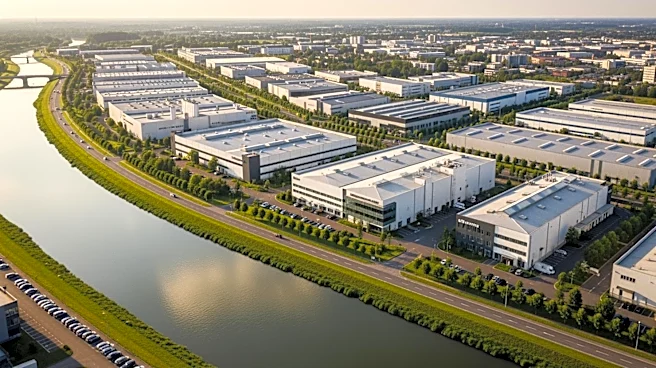
in Accra, aims to provide technical expertise for large-scale infrastructure planning and development. The Volta Economic Corridor is envisioned as Ghana's first net-zero green industrial zone, integrating agriculture, manufacturing, and logistics. The project is expected to boost agro-industrial production, exports, and job creation. The collaboration builds on previous engagements in Changsha, China, focusing on spatial planning and infrastructure design. The corridor will run from Tema through several regions to Tamale, with plans to convert over two million hectares of arable land into agroecological parks linked to industrial parks. The initiative is expected to generate over 500,000 direct jobs and reduce reliance on imports.
Why It's Important?
This collaboration marks a significant step in Ghana's industrial transformation strategy, aiming to position the country as a competitive exporter in global markets. By focusing on infrastructure development and spatial planning, the project seeks to attract private investment and enhance Ghana's manufacturing and agro-processing competitiveness. The partnership with Hunan brings expertise in engineering and construction, crucial for implementing Ghana's long-term economic goals. The project aligns with the government's vision for sustainable economic growth, transitioning from a resource-dependent economy to a value-added production hub. The initiative also underscores the importance of international cooperation in achieving national development objectives, with support from institutions like the African Development Bank.
What's Next?
The next steps involve commencing pilot projects for two industrial parks and three agroecological parks within the corridor. These pilots will test design concepts and refine implementation models before scaling up. The government plans to deploy renewable energy solutions along the corridor to reduce electricity costs, enhancing competitiveness. Technical training and knowledge exchange are also part of the agreement, aimed at building local expertise in large-scale project planning. The collaboration is expected to accelerate Ghana's transition to an export-led industrialisation model, with rapid deployment of technical teams and delivery of detailed spatial plans anticipated in the near term.