



What's Happening?
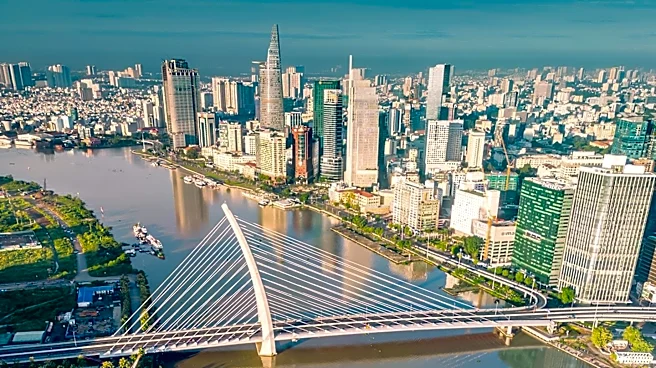
A World Bank Group study, supported by the Swiss Confederation through SECO, has analyzed Thu Duc, a major center in Ho Chi Minh City, Vietnam. The study reveals that Thu Duc's current productivity is only about one-third of the Ho Chi Minh City average,
and its residential amenities are roughly two-thirds of metropolitan levels. Key factors preventing Thu Duc from reaching its economic potential include persistent flooding, connectivity gaps, land-development constraints, and weaker urban services. Under a business-as-usual scenario, Thu Duc is projected to have 1.02 million residents, 530,000 jobs, and a Gross Value Added (GVA) of approximately US$13.9 billion by 2040. The study emphasizes that treating flood exposure solely as a disaster management issue is insufficient, as it significantly discourages business investment, reduces neighborhood attractiveness, and limits urban development. A one-percentage-point increase in flood exposure is linked to a 2.6% lower manufacturing productivity and 1.1% lower local-services productivity, with residential amenities also being 0.9-1.1% lower.
Why It's Important?
This study highlights the critical role of integrated urban planning and climate adaptation in economic development, offering valuable lessons for fast-growing, climate-vulnerable cities globally, including those in the U.S. The findings demonstrate that climate adaptation, when integrated into economic and urban-development planning, can become a powerful tool for economic growth rather than just a cost. For U.S. cities facing similar challenges of urban expansion and climate risks, the coordinated investment strategy proposed for Thu Duc could serve as a model. It underscores that infrastructure projects alone are not enough; a holistic approach encompassing flood resilience, transport, land management, housing, utilities, and public services is essential for sustainable growth. This approach could attract private investors in resilient real estate, manufacturing, logistics, technology, construction, and urban services, provided there is strong government action on infrastructure and land regulation. The study also points to the inclusion risk, where high-skilled residents might benefit while low-skilled residents face declining real per capita income due to increased living costs, emphasizing the need for affordable housing and inclusive land policies to prevent economic transformation from displacing vulnerable populations.
What's Next?
For Thu Duc, the study suggests that a coordinated investment strategy, combining innovation zones, flood mitigation, improved transport connectivity, and land policy reforms, could raise its GVA by approximately 65% above the business-as-usual trajectory. This would involve implementing proposed drainage infrastructure, embankments, and canal management to significantly reduce flood exposure, leading to substantial productivity increases across various sectors. Policymakers are encouraged to plan innovation, flood resilience, transport, and land development together. International development partners have an opportunity to move beyond narrowly designed climate projects and finance a broader range of initiatives to generate wider productivity and development benefits. For private investors, opportunities are expected to emerge in resilient real estate and urban services, contingent on government actions. The long-term progress for Thu Duc will also necessitate improvements in education, healthcare, utilities, public services, land governance, and urban planning to achieve inclusive urban growth.
Beyond the Headlines
The study's insights extend beyond Thu Duc, offering a blueprint for urban development in other rapidly growing and climate-vulnerable cities worldwide, including those in the U.S. It challenges the conventional separation of climate adaptation from economic planning, advocating for their integration to unlock significant economic potential. The ethical dimension of inclusive growth is also prominent, as the study warns against the potential for economic transformation to exacerbate inequalities if not managed with policies for affordable housing and accessible transport. This highlights a critical societal challenge: ensuring that urban development benefits all residents, not just the high-skilled. Legally and culturally, the findings could influence land-use policies and urban planning regulations, pushing for more resilient and equitable development frameworks. The long-term shift could be towards a more holistic understanding of urban resilience, where environmental protection, economic growth, and social equity are seen as interdependent components of sustainable development, rather than isolated objectives.