

What's Happening?
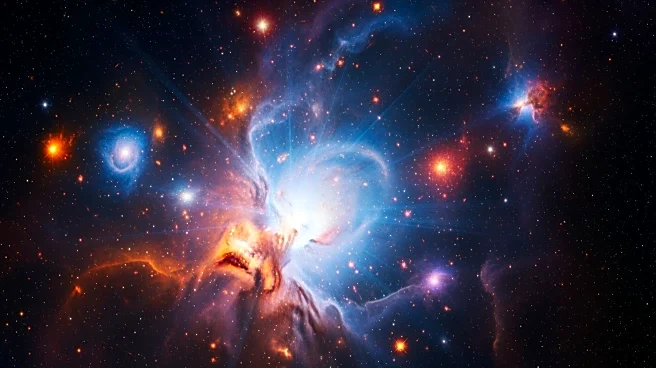
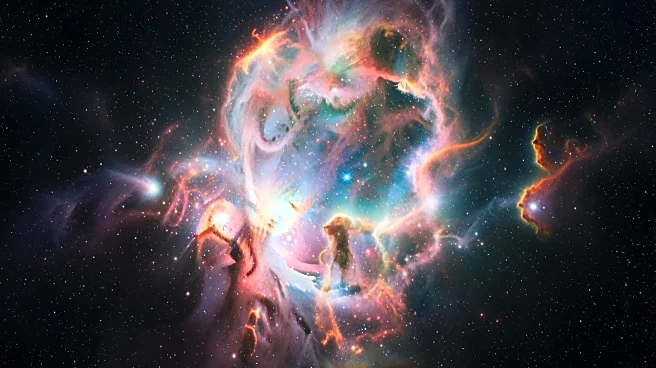
NASA's James Webb Space Telescope has captured detailed images of the Cranium Nebula, a cloud of gas and dust surrounding a dying star. The nebula, resembling a brain in a transparent skull, was first observed by the Spitzer Space Telescope. Webb's advanced
instruments have revealed distinct regions within the nebula, including an outer shell of hydrogen and an inner cloud with various gases. The images show a dark lane running through the nebula, possibly indicating an outburst from the central star. This observation provides insight into the star's end-of-life processes.
Why It's Important?
The Webb Telescope's findings enhance our understanding of stellar evolution and the processes occurring in dying stars. This research contributes to broader astronomical knowledge, potentially informing theories about the life cycles of stars and the formation of nebulae. The ability to capture such detailed images demonstrates Webb's capabilities in advancing space science, offering new opportunities for discoveries about the universe's structure and origins.