
What's Happening?
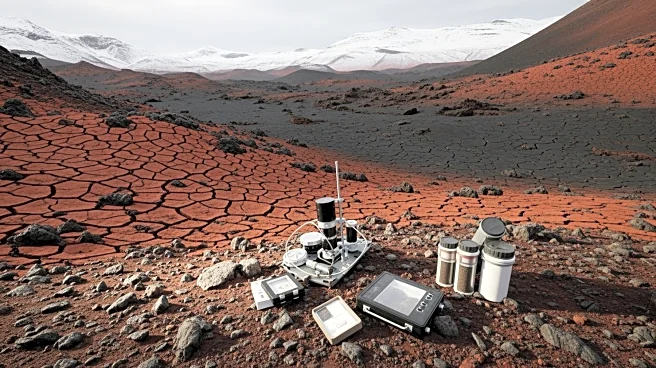
NASA's Goddard Instrument Field Team, known as 'Team Carb', is conducting fieldwork in Southwest Iceland, focusing on Lake Kleifarvatn. This lake is of particular interest due to its volcanic and mineral
composition, which closely resembles Martian terrains such as Gale and Jezero craters. The team is investigating preserved organic molecules and specific mineral patterns that form in the presence of water and heat, conditions that could have supported life on early Earth and potentially on Mars. The research aims to guide Mars rovers in identifying signs of ancient habitability. The team is particularly interested in carbonates, minerals that can store carbon and provide insights into the historical habitability of Mars. The fieldwork involves collecting sediment samples from the lake, a challenging task due to the cold water and the need to avoid contamination.
Why It's Important?
This research is significant as it enhances our understanding of Mars' potential to have supported life. By studying environments on Earth that mimic Martian conditions, scientists can better prepare for future Mars missions, particularly in identifying signs of past life. The findings could influence the design and objectives of Mars rovers, making them more efficient in their search for life. Additionally, understanding the formation and storage of carbonates on Mars could provide insights into the planet's climate history and its capacity to support life. This research not only advances planetary science but also contributes to our understanding of Earth's geological history and the conditions that led to the emergence of life.
What's Next?
The insights gained from this fieldwork will likely inform the development of future Mars missions, particularly in the selection of landing sites and the design of instruments for detecting signs of life. The collaboration between Team Carb and other research groups, such as Team Gas, suggests a multidisciplinary approach that could enhance the overall understanding of Martian geology and potential habitability. As the research progresses, findings will be shared with the broader scientific community, potentially influencing the direction of planetary exploration and astrobiology research.
Beyond the Headlines
The ethical and scientific implications of this research are profound. It raises questions about the preservation of extraterrestrial environments and the potential for contamination by Earth-based organisms. The study also highlights the importance of international collaboration in space exploration, as understanding Mars' history could have implications for global scientific and technological advancements. Furthermore, the research underscores the interconnectedness of Earth's geological history with that of other planets, offering a broader perspective on the conditions necessary for life.