
What's Happening?
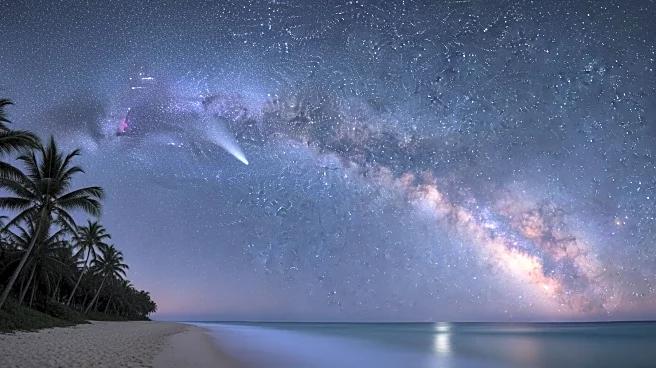
Comet C/2025 A6, commonly known as Comet Lemmon, has become a celestial highlight for stargazers in Hawaii. Discovered in January 2025, the comet made its closest approach to Earth in late October 2025.
By November, it had brightened to a visibility comparable to the planet Uranus, allowing it to be seen with the naked eye from suburban areas. The comet was observed from the peak of Mauna Kea, a volcanic summit on the Big Island of Hawaii, where the reduced light pollution enhances the visibility of celestial events. The comet's appearance was framed by the glow of the Milky Way, providing a stunning visual experience. This event is particularly significant as Comet Lemmon will not return to Earth's skies for another 1,350 years, making this a once-in-a-lifetime opportunity for observers.
Why It's Important?
The visibility of Comet Lemmon offers a rare opportunity for both professional astronomers and amateur skywatchers to observe a celestial event that will not recur for over a millennium. Such events can inspire interest in astronomy and science, potentially influencing educational and career paths. Additionally, the comet's appearance highlights the importance of preserving dark sky areas, like Mauna Kea, which are crucial for astronomical observations. The event also underscores the unpredictability of comets, which can vary greatly in visibility and trajectory, making each appearance unique and scientifically valuable.
What's Next?
While Comet Lemmon will not return for over a thousand years, its recent visibility may encourage increased public interest in astronomy and skywatching. This could lead to more support for preserving dark sky areas and funding for astronomical research. Additionally, the event may prompt further studies into the behavior and composition of comets, contributing to our understanding of the solar system. For now, astronomers and enthusiasts will continue to monitor other celestial events and prepare for future comet appearances.
Beyond the Headlines
The appearance of Comet Lemmon also raises awareness about the impact of light pollution on astronomical observations. As urban areas expand, preserving locations like Mauna Kea becomes increasingly important for scientific research. The event may also spark discussions about the cultural significance of celestial phenomena, as many cultures have historical and mythological connections to comets and the night sky. This could lead to a broader appreciation of the night sky as a shared human heritage.