
What's Happening?
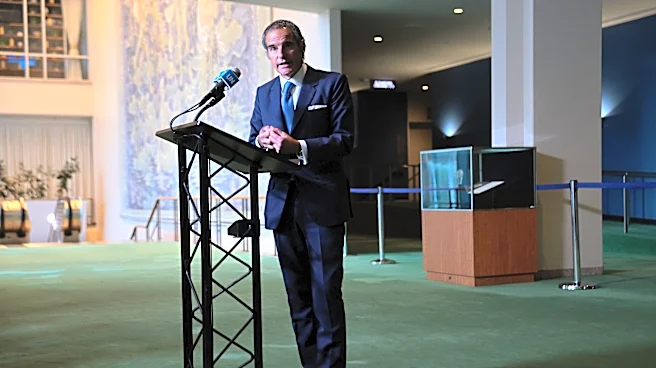
Rafael Grossi, the head of the International Atomic Energy Agency (IAEA), has described the inspection provisions within a planned US-Saudi nuclear deal as 'very satisfactory.' This agreement, a proposed
civil nuclear cooperation known as a 123 agreement, is currently awaiting approval from US lawmakers. While the deal allows for snap inspections, these are limited to declared sites, not extending to undeclared locations as would be permitted under the more intrusive Additional Protocol. Nonproliferation experts have voiced criticism, noting that the deal does not explicitly prohibit Riyadh from enriching uranium or reprocessing spent reactor fuel, both of which are potential pathways to developing nuclear weapons. Saudi Arabia has a nascent nuclear program and has recently signed a Comprehensive Safeguards Agreement with the IAEA, which mandates inspections of declared nuclear facilities. The US-Saudi text on nuclear safeguards, reviewed by Reuters, specifies that activities like enrichment and reprocessing will only occur 'on a location on a covered site' and grants the IAEA 'short notice access' to these locations.
Why It's Important?
This development is significant for U.S. foreign policy and nuclear nonproliferation efforts in the Middle East. The U.S. is seeking to strengthen its strategic alliances in the region, and a nuclear cooperation agreement with Saudi Arabia is a key component of this strategy. However, the deal's perceived shortcomings regarding enrichment and reprocessing raise concerns among nonproliferation advocates about the potential for nuclear proliferation in a volatile region. If Saudi Arabia were to develop nuclear weapons, as Crown Prince Mohammed bin Salman has indicated it would if Iran does, it could trigger a regional arms race, destabilizing global security. The absence of the Additional Protocol in the US-Saudi agreement, which allows for more intrusive inspections, contrasts with Iran's past agreement to implement it under the 2015 nuclear deal before the US withdrawal under President Trump. This disparity could set a precedent for future nuclear agreements, potentially weakening international nonproliferation standards.
What's Next?
The proposed US-Saudi nuclear deal still requires approval from US lawmakers, where it faces scrutiny from nonproliferation experts and potentially from members of Congress concerned about its implications. The IAEA's board will also need to approve the safeguards text. The ongoing debate will likely focus on whether the current inspection provisions are robust enough to prevent proliferation and if additional safeguards, such as a ban on enrichment and reprocessing, should be included. The outcome of these discussions will influence the future of nuclear cooperation agreements and the broader nonproliferation regime. Furthermore, the stance of Saudi Arabia, particularly its commitment to not pursuing nuclear weapons if Iran does not, will remain a critical factor in regional stability.
Beyond the Headlines
The US-Saudi nuclear deal highlights a complex geopolitical balancing act for the United States. On one hand, it aims to bolster strategic partnerships and counter regional adversaries. On the other, it grapples with the ethical and security implications of potentially enabling a new nuclear program in a region already fraught with tension. The debate over the Additional Protocol underscores a fundamental tension in nuclear diplomacy: the desire for robust verification versus national sovereignty and technological aspirations. The precedent set by this deal could influence other nations seeking civil nuclear technology, potentially leading to a fragmentation of nonproliferation standards. The long-term implications involve not only the risk of nuclear weapons proliferation but also the erosion of international arms control frameworks, making future efforts to manage nuclear risks more challenging.