







What's Happening?
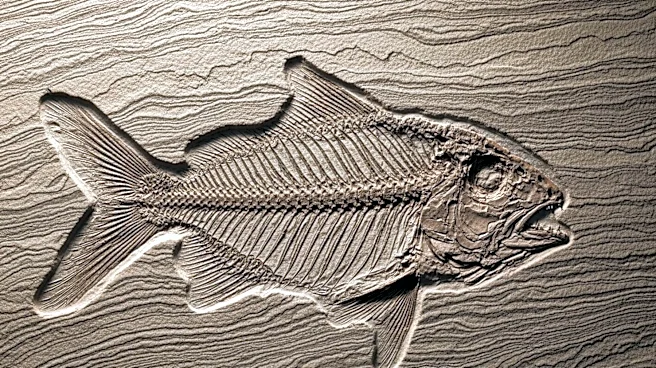
Researchers from the Chinese Academy of Sciences' Institute of Vertebrate Paleontology and Paleoanthropology have discovered a 436-million-year-old bony fish fossil in South China. Named Eosteus chongqingensis, this fossil is the oldest near-complete,
articulated bony fish fossil ever found, providing new insights into vertebrate evolution. The discovery fills a significant gap in the fossil record from the Silurian period, a time when marine life thrived in warmer waters. The fossil reveals traits that have been sorted into separate lineages, suggesting that features associated with bony fish emerged earlier than previously thought. Additionally, the team identified another Silurian-period fish, Megamastax amblyodus, which was an apex predator of its time.
Why It's Important?
This discovery is crucial for understanding the evolutionary history of vertebrates, as it provides evidence of early bony fish traits and their development. The findings challenge previous assumptions about the timeline of vertebrate evolution, suggesting that key features emerged earlier than believed. This has implications for the study of biodiversity and the evolutionary processes that led to the vast array of vertebrate species today. The research also highlights the importance of fossil records in reconstructing the history of life on Earth, offering a clearer picture of how ancient marine environments influenced the diversification of species.