
What's Happening?
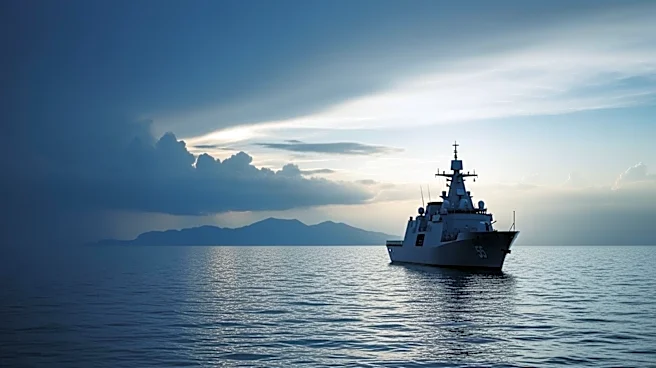
President Donald Trump has announced the continuation of a naval blockade against Iran, aimed at pressuring Tehran into agreeing to a nuclear deal. The blockade, which restricts Iran's ability to export
oil through the Strait of Hormuz, is part of a broader strategy to force Iran into negotiations by inflicting economic pain. Despite President Trump's assertion that Iran's oil infrastructure is on the brink of collapse, experts suggest that Iran has sufficient oil storage capacity to manage its production without immediate damage. The blockade has significantly reduced Iran's oil exports, with loadings dropping from 2.1 million barrels per day to just 567,000 barrels per day. This situation has led to a substantial economic impact, with Iran reportedly losing $500 million daily due to the blockade.
Why It's Important?
The blockade represents a critical point in U.S.-Iran relations, with significant implications for global oil markets and geopolitical stability. The Strait of Hormuz is a vital chokepoint for global oil supply, and its closure could lead to increased oil prices and economic instability worldwide. The U.S. strategy aims to leverage economic pressure to bring Iran back to the negotiating table, but it also risks escalating tensions in the region. The prolonged blockade could strain U.S. relations with other countries dependent on Middle Eastern oil and may lead to broader economic repercussions if the situation remains unresolved.
What's Next?
The ongoing blockade is expected to continue until either side concedes to negotiations. Iran's ability to withstand the economic pressure will be tested as its oil storage capacity nears its limit. The U.S. may face increasing pressure from international allies and economic stakeholders to find a diplomatic solution. The situation remains fluid, with potential for either escalation or resolution depending on diplomatic engagements and Iran's economic resilience.