


What's Happening?
After 17 years of development, China's Jiangmen Underground Neutrino Observatory (JUNO) has commenced operations, marking a significant milestone in particle physics. Located 700 meters underground in Guangdong province, the 20,000-ton detector is designed
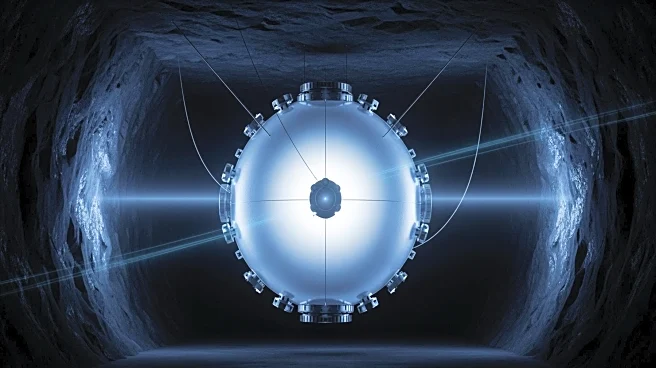
to study neutrinos, elusive particles that pass through matter without interaction. JUNO's primary mission is to determine the mass hierarchy of neutrinos, a long-standing question in physics. The facility, which began collecting data on August 26, 2025, has already achieved unprecedented precision in measuring solar neutrino oscillation parameters, surpassing previous experiments. The detector's design includes a 35.4-meter-wide acrylic sphere filled with liquid scintillator, surrounded by over 43,000 photomultiplier tubes, ensuring high sensitivity to neutrino interactions.
Why It's Important?
JUNO's early success in achieving high precision in neutrino measurements could lead to resolving the neutrino mass hierarchy, a fundamental question in particle physics. Understanding neutrino properties is crucial for the broader comprehension of the universe's fundamental forces and particles. The project's international collaboration, involving over 700 scientists from 75 institutions across 17 countries, highlights its global significance. The findings from JUNO could potentially validate or challenge existing theories in particle physics, paving the way for new discoveries. The detector's ability to monitor various neutrino types, including those from supernovae and radioactive processes within Earth, underscores its potential to contribute to multiple areas of scientific research.
What's Next?
As JUNO continues its operations, it is expected to provide more precise data on neutrino oscillations, which could confirm or refute current models of neutrino mass ordering. The ongoing analysis will also test the three-flavor oscillation framework and explore new physics beyond the standard model. The project's success depends on maintaining the detector's high purity and calibration standards, which have been meticulously established. Future results from JUNO could influence theoretical physics and guide future experiments in neutrino research. The scientific community eagerly anticipates further findings that could reshape our understanding of particle physics.